
LEARNING CENTER WATER HEATERS
How much does a tankless water heater cost in Louisville (installed)?
The short answer
A tankless water heater in Louisville runs $5,300–$6,600 installed for a natural gas unit. The low end is a mid-efficiency indoor tankless. The high end adds a built-in recirculation pump and a longer heat-exchanger warranty. Budget about $500–$600 a year to flush it, because our hard water scales the heat exchanger.
Most folks ask about tankless because they heard “endless hot water” and “saves space.” Both hold up. Where people get surprised is the install price. A tankless costs a good bit more than a standard tank, and most of that extra money goes to the work behind the wall rather than the unit hanging on it.
What a tankless costs installed here
Here are the numbers from our pricebook. Our entry natural gas tankless, a mid-efficiency indoor unit, installs at $5,300–$5,500. Step up to the high-efficiency model with a built-in recirculation pump and you’re at $6,400–$6,600. Both run on gas. We don’t put in electric tankless, and for most Louisville homes gas is the better fit anyway.
Why the price swings about a thousand dollars
That thousand-dollar spread comes down to a few things, and a fancier unit is only part of it:
- Efficiency and the pump The high-efficiency unit gets hot water to the tap faster with a built-in recirculation loop, and it carries a longer heat-exchanger warranty. You’re paying for a shorter wait at the tap and a few more years of life.
- The gas line A tankless fires far more BTU than a tank does. Your existing gas line often can’t feed it, so we run a bigger line back toward the meter. The longer that run, the more the job costs.
- Dedicated venting Tankless needs its own sealed venting. The old tank flue won’t work here, so we run new pipe and cut new penetrations through the wall.
- Electrical Even a gas tankless needs a dedicated circuit for its controls and igniter. If there’s no power where the unit goes, that’s an add.
The pricier unit is also more work on our end. Our high-efficiency install books at 6.5 labor hours against 4.73 for the entry model. You’re paying for a bigger job with more gas and venting work rolled in, not just a nicer part on the wall.
How that stacks up against a regular tank
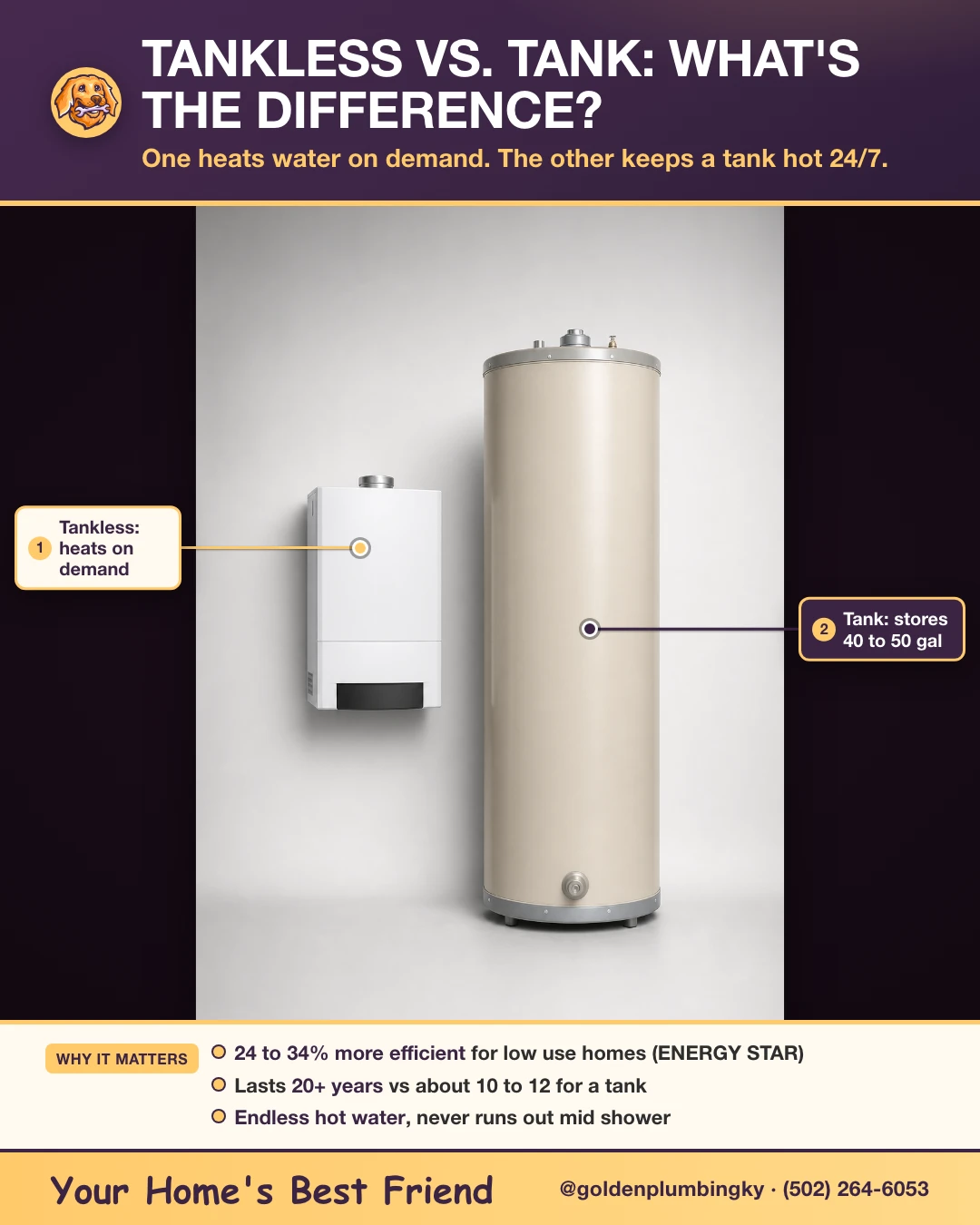
A standard 50-gallon natural gas tank installs at $2,300–$2,500. So a basic tank runs less than half of a tankless, and that’s the number people picture when they call tankless expensive. The comparison shifts with your house, though. If your setup needs a power-vent tank, you’re at $5,200–$5,400 installed, which is right in tankless territory. Tankless starts about where a mid-to-high tank lands and climbs from there.
The yearly cost most people skip
Tankless units need a flush, and we charge $500–$600 to descale one. On Louisville water, plan on doing it every year. Our tap runs about 7.2 grains per gallon, moderately hard, drawn from the Ohio River. That mineral scale cakes up inside the heat exchanger, and a tankless is far fussier about it than a tank. Let it go a few years and you’ll be shopping for a new heat exchanger, which is the priciest part of the whole machine.
When a tankless is the wrong buy
We’ll talk you out of one when it doesn’t fit. A standard tank is the smarter money in a few situations:
- Tight budget If the upfront price is the deciding factor, a standard tank does the same core job for under half the install cost.
- Low hot-water demand A small household that never runs out of hot water on a tank won’t feel the upgrade. You’d pay more to fix a problem you don’t have.
- No gas-line headroom Tankless needs serious gas supply. If your line or meter can’t feed it and the upsize is a long run, the extra cost can blow right past the value.
That last one comes up a lot. Tankless is the exception in the homes we serve. Of the water heaters we put in, only about 1 in 10 are tankless. Most Louisville homes still go with a tank, and for most of them that’s the right call.
Common questions we get
Does a tankless really give endless hot water?
Yes, within its flow rating. It heats water on demand, so it won’t run dry the way a tank does mid-shower. Undersize it, though, and two showers plus the dishwasher can outrun it. That’s why sizing matters more than the brand on the front.
Will a tankless lower my gas bill?
Some. You stop paying to keep 50 gallons hot around the clock. The monthly savings are steady but modest, and they won’t cover the higher install price on their own. Buy tankless for the hot water and the wall space you get back; a lower bill is a nice bonus, not the reason.
How long does a tankless last?
Longer than a tank, usually. Our high-efficiency unit carries a 12-to-15-year heat-exchanger warranty and 5 years on parts. The entry unit runs 10 to 12 years on the exchanger, 5 on parts. Annual flushing is what gets you to the high end of those numbers.
Can you put a tankless where my old tank was?
Sometimes, not always. It needs new venting, usually a bigger gas line, plus a dedicated circuit for the controls. We check your gas supply and venting before we quote, so the price we give you holds up on install day.
What does it cost just to diagnose a tankless problem?
Our tankless diagnostic is $128.65. That covers the visit to find out what’s wrong before we quote any repair.
The next questions to ask
Not sure if tankless is worth it for your home?
Ask Goldie for a straight answer at goldenplumbingky.com/instant-estimate/