
LEARNING CENTER WATER HEATERS
Why your water heater’s pilot light won’t stay lit (thermocouple, drafts, and when to call)
The short answer
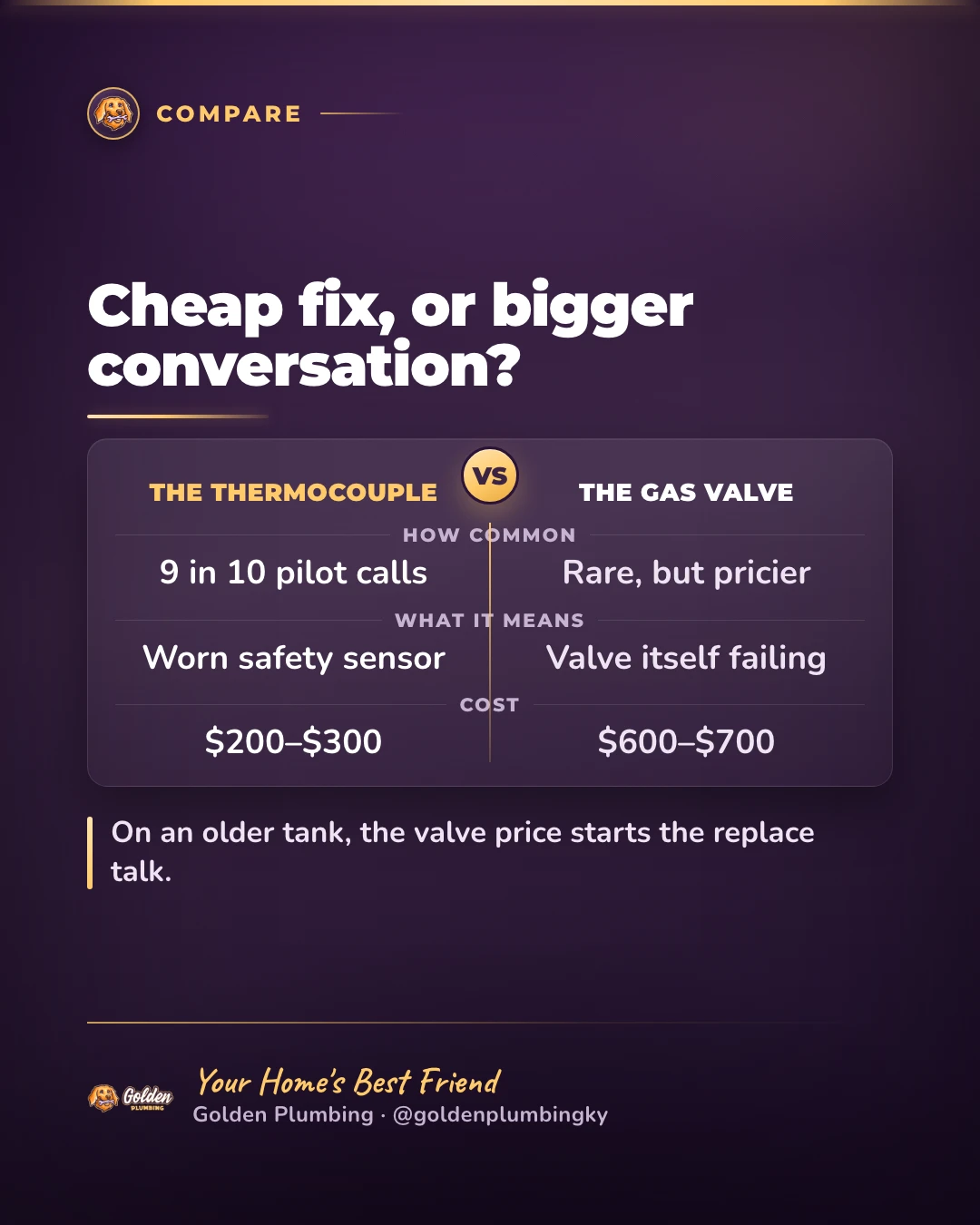
Hold the button and the pilot lights, let go and it dies: that’s the classic sign of a worn thermocouple, the little copper sensor that sits in the pilot flame and holds the gas valve open only while it’s hot. When it can’t prove the flame exists anymore, the valve snaps the gas shut, which is your heater’s safety system doing its job, not failing. Replacing a thermocouple runs $200–$300. If the pilot lights fine but dies hours or days later, think drafts and a dirty pilot before you think parts. And if a healthy thermocouple still won’t hold, the gas control valve at $600–$700 is the next suspect, and on an older tank that price starts the repair-or-replace conversation.
If you’ve spent part of your evening kneeling on the basement floor, holding a button and counting to sixty, you’re in good company. The pilot light call is one of the most common water heater calls we run in Louisville, and it follows a script: the flame catches while you hold the button, dies the second you let go, and by the third round you’re wondering if the whole heater is shot. Almost never. Most of the time it’s one small part, and understanding one little safety circuit will tell you which part. One note before we start: if your heater is electric, there’s no pilot on it at all, so start with our no hot water checklist instead.
Why the flame dies the second you let go
Down in the burner chamber, sitting right in the pilot flame, is a copper rod about the size of a pencil stub. That’s the thermocouple, and it has exactly one job: prove the flame exists. While the pilot burns, the flame bathes the tip and the heat generates a tiny electric current. That current runs up a copper line to the gas control valve and powers a small electromagnet that holds the pilot gas open. Flame out means no heat, no heat means no current, and no current means the magnet lets go and the valve snaps shut, usually within about 30 seconds.
That snap is the whole point. Without it, a pilot that blew out at 2 a.m. would quietly dump raw gas into your basement all night. So when your pilot won’t stay lit, the safety system isn’t broken. It’s doing exactly what it was built to do. The real question is why it thinks the flame is missing, and there are only a handful of answers.
Holding the button down is you doing the magnet’s job by hand while the tip warms up. That’s why the label says to hold it for 30 to 60 seconds before letting go. Release too early and even a perfectly healthy thermocouple hasn’t made enough current yet, and the flame dies through no fault of the parts. Worth ruling out before you blame anything.
The usual suspects, most likely first
- A worn-out thermocouple (the usual answer) This is the pilot call nine times out of ten. Years in a flame corrode and fatigue the tip until it can’t make enough current to hold the valve, even when the flame looks perfect. The giveaway: the pilot burns fine while you hold the button, then dies the moment you release it, or within a minute after. Replacing a thermocouple runs $200–$300, and it’s a same-visit fix.
- A weak, lazy pilot flame A healthy pilot is a crisp blue cone wrapping the thermocouple tip. If yours is small, yellow, and wavering, the pilot orifice is likely half plugged with dust or scale, and a lazy flame can’t get the tip hot enough no matter how new the thermocouple is. Cleaning and adjusting the pilot is part of a normal diagnosis, not a big repair.
- A draft finding its way in Pilot flames are the size of your thumbnail, and they get snuffed. A basement door that funnels wind, a flue pushing a downdraft on gusty days, or a furnace, dryer, and bath fan all pulling air out of a tight utility room at once can starve or blow out a flame that small. The tell is the pattern: the pilot only dies on windy nights, or when certain appliances run. The thermocouple tests fine, because nothing’s wrong with it.
- A clogged air screen underneath Most gas heaters made since the early 2000s have a sealed burner chamber that breathes through a flame-arrestor screen down near the floor. Lint, dust, and pet hair clog that screen, the flame slowly suffocates, and the pilot dies for lack of air. Heaters that share a room with the dryer are the classic case. Vacuuming the screen and the base ring is a five-minute chore that fixes more pilot problems than people expect.
- The gas control valve itself Least common and most expensive. If the thermocouple is new or tests strong and the pilot still won’t hold, the electromagnet inside the gas control valve is usually the part that’s given up. Replacing the valve runs $600–$700, and on an older tank that number changes the conversation from repair to replacement. We’ll walk you through that math honestly instead of defaulting to the bigger ticket.
What you can safely try before you call
- Relight it once, by the label Every gas heater has its relight steps printed on the tank. The short version: turn the knob to Pilot, hold it down, click the igniter, and keep holding for a full 30 to 60 seconds before you let go. A good share of the relight failures we see are just an early release. If it catches and holds, you’re done. An occasional blowout isn’t a crisis.
- Watch the flame while you hold the button You can usually see the pilot through the little sight glass near the floor. You want a steady blue flame wrapping the tip of the thermocouple. A small, yellow, flickering flame is telling you the pilot is dirty or the chamber is starving for air, and no new part fixes that.
- Hunt the pattern If the pilot dies on windy nights, after storms, or whenever the dryer runs, you’re likely chasing a draft, not a part. Write down when it happens. That one detail can turn a guessing game into a ten-minute diagnosis, and it’s the first thing we’d ask about on the phone anyway.
- Vacuum the base of the heater Run a vacuum brush around the bottom ring of the heater and over the intake screen if you can see one. It’s free, it takes five minutes, and in laundry rooms it’s the actual fix more often than people believe.
If it dies twice in a row after all that, stop relighting. The ritual isn’t fixing anything, and every round is telling you the same thing: the circuit doesn’t trust the flame. That’s the point where a diagnosis earns its keep.
Stop and make a phone call instead if
Most pilot problems are safe to poke at. These three aren’t, and we’d rather you hear it from us:
- You smell gas A rotten-egg smell near the heater means stop relighting entirely. Don’t flip switches and don’t hunt for the source. Get everyone outside and call LG&E from the sidewalk, then call a plumber once the utility clears the house. A pilot problem can wait. A gas leak can’t.
- You see soot or scorch marks Black staining on top of the tank or around the chamber door, a burner that roars, or a flame that lifts and flutters means combustion gases aren’t going where they should. That’s a venting and safety problem, not a relight, and it deserves same-day eyes because the same backdraft can carry carbon monoxide.
- It’s the third relight this week At that point the relight is a symptom, not a solution. Something in the circuit is failing a little more each day, and the honest move is to find out which part before it strands you with a cold shower on a school morning.
What the fixes cost, in plain numbers
Here are the numbers so nothing surprises you. A pilot relight visit, where we get it lit, confirm the flame is healthy, and check the draft picture, runs under $100. A full gas water heater diagnosis also runs $100–$200 and pins down which of the suspects above you actually have, which matters because the fixes are priced a world apart. A thermocouple replacement is $200–$300. A gas control valve is $600–$700. And if your tank is past about ten years old, that valve price is where we’d talk honestly about whether the money belongs in a repair or a replacement, because a standard 50-gallon gas replacement runs $2,200–$2,400 and the new tank comes with a new valve, a new pilot assembly, and a warranty. One timing note: if the pilot dies at 9 p.m., an after-hours visit runs $199. Unless something above says safety, waiting for morning is usually the better spend, and yes, we’re telling you not to pay us extra.
Common questions we get
Is it dangerous that my pilot light keeps going out?
The going-out part, no. The system that cuts the gas when the flame dies is doing its job, and no raw gas flows once the valve snaps shut. The exceptions are worth respecting: a gas smell anywhere near the heater, soot or scorch marks around the burner chamber, or a pilot that dies during high winds in a house with other vented appliances. Those point to leaks, combustion trouble, or backdrafting, and each one earns a same-day call rather than another relight.
Can I replace a thermocouple myself?
Handy homeowners do it, and the part itself is cheap at the hardware store. The honest caution: on most heaters built since the early 2000s the burner chamber is sealed, so the whole pilot assembly comes out as a unit through a gasketed door, and you’re breaking and remaking gas fittings to do it. Cross-thread one or reseat that door badly and you’ve traded a pilot problem for a leak. If you’re comfortable with gas connections and a soap-bubble leak test, it’s a fair Saturday job. If you’re not, this is exactly what the $200–$300 version buys.
How long does a thermocouple last?
There’s no fixed clock, but a decade spent sitting in a flame is a long life for a small copper part, and on heaters past the ten-year mark the thermocouple is often the first thing to quit. That’s also why age matters in the repair decision. A thermocouple on a six-year-old tank is an easy yes. The same part on a thirteen-year-old tank still fixes the pilot, but the tank around it is on borrowed time, and we’d say so before you spend the money.
Why does my pilot only go out on windy nights?
Because wind can shove air down the flue faster than the exhaust rises, and that downdraft snuffs a flame the size of your thumbnail. Homes where the water heater shares air with a furnace, a dryer, or bathroom fans are more prone, because running those pulls air out of the room and invites the backdraft. If the pattern is that clean, weather event then dead pilot, the fix is about venting and combustion air rather than parts, and it’s worth a look because the same backdraft that kills the pilot can push exhaust into the house.
My heater has a blinking status light instead of a pilot button. Is this the same problem?
Same physics, newer hardware. Heaters with an electronic gas valve use a thermopile, which is a beefier stack of thermocouples that also powers the controls, and the status light blinks a code that tells you what the valve is unhappy about. The blink count maps to a specific fault on the sticker inside the front of the unit. A pilot that won’t hold on these units is still usually the thermopile, and a gas water heater diagnosis at $100–$200 reads the code and tests the part instead of guessing.
The next questions to ask
Pilot out again and tired of the relight ritual?
Ask Goldie walks you through it in a couple of minutes and tells you whether you’re looking at a cheap part or a bigger conversation. Try it at goldenplumbingky.com/instant-estimate/