
LEARNING CENTER GENERAL
Plumbing inspections when buying or selling a Louisville home: what we check and what it saves you
The short answer
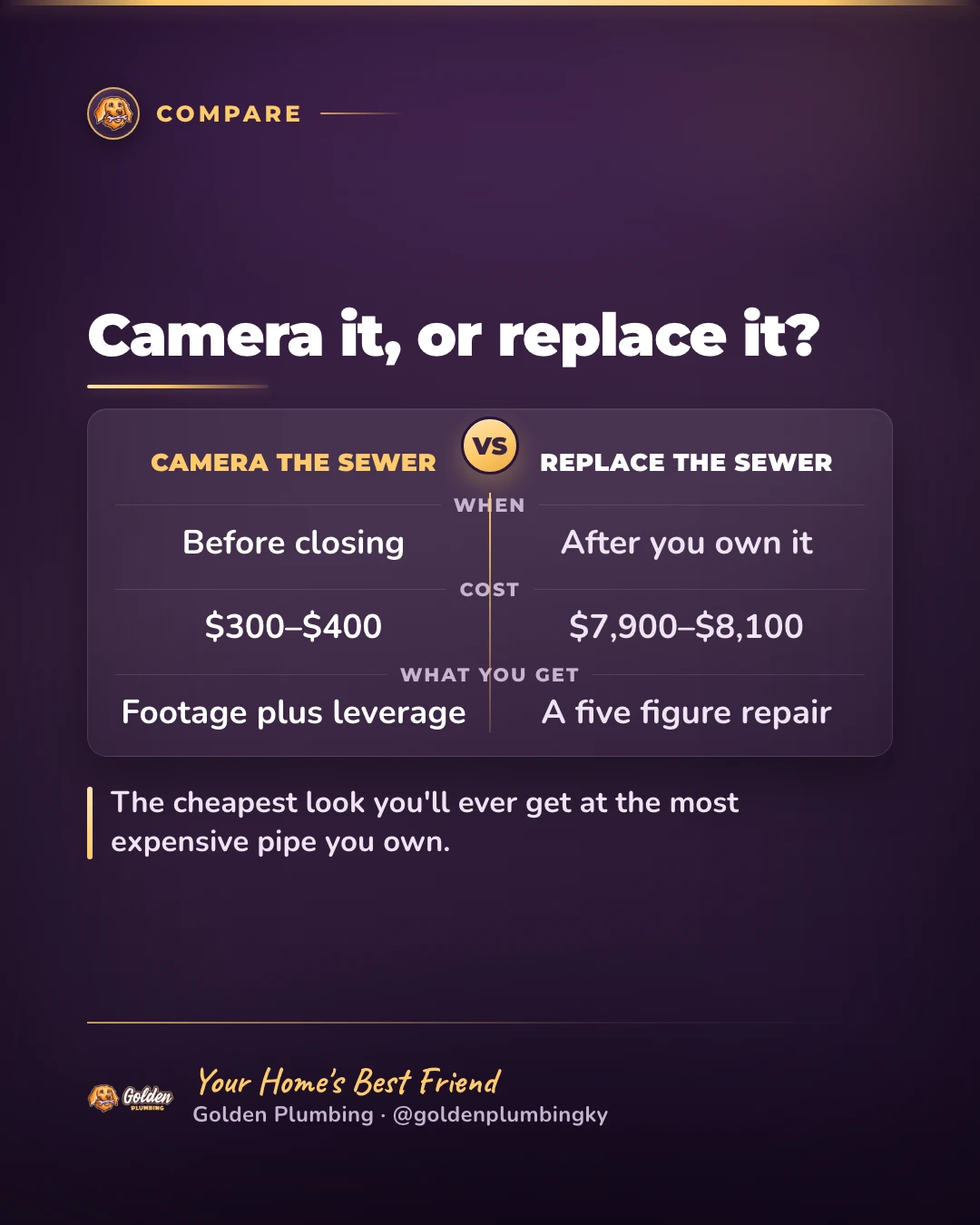
Buying: yes, and the sewer camera is the part that matters most. A general home inspection is a visual once-over. The inspector runs the faucets, flushes the toilets, and looks at whatever pipe is showing, but nobody can see inside the sewer lateral, and in Louisville’s older neighborhoods that buried clay pipe is the single most expensive thing that can be wrong with a house. A camera inspection runs $300–$400; the full sewer replacement it can catch starts around $7,800–$8,000. Selling: a pre-listing plumbing check costs $89 and keeps a mid-deal surprise from knocking thousands off your price at the worst possible moment.
A house is the biggest check most people ever write, and the plumbing is the part of it you can’t see from the driveway. We get called into a lot of Louisville home sales. Sometimes by the buyer, sometimes by the seller, and sometimes after closing, when the surprise has already happened. That last group is the one we’re trying to shrink with this article. Here’s what a general home inspection actually covers, what it physically can’t, what a dedicated plumbing inspection adds, and the honest math on when it’s worth paying for.
What the home inspector checks, and what nobody can see
First, credit where it’s due. Home inspectors do real work, and a good one earns their fee. But a general inspection is visual and functional by design. The inspector runs the faucets, flushes the toilets, checks under sinks for active leaks, and looks at whatever pipe and water heater happen to be exposed. Plumbing gets a slice of a three or four hour visit, because they’ve got a whole house to cover: roof, electrical, foundation, HVAC, everything.
The problem is what that approach can’t reach. The most expensive plumbing problems in a Louisville house are almost never at the fixtures. They’re underground in the sewer lateral, inside the water heater, buried in a wall, or hiding in the pressure the whole system runs at. None of it shows up on a walkthrough, which is why the report language reads the way it does: functioned normally at the time of inspection.
What a real plumbing inspection covers
- The sewer lateral, with a camera This is the headliner, and it gets its own section below. The lateral is the buried pipe carrying everything from the house to the city main, it’s the homeowner’s responsibility rather than MSD’s, and in older neighborhoods it’s often hundred-year-old clay. A camera inspection runs $300–$400 and shows you exactly what you’re buying, on footage you can keep.
- The water heater, honestly aged We read the manufacture date off the serial number, not off anyone’s guess, and look for sediment, rust at the fittings, and whether the install was done right. Most tanks last about 8 to 12 years, and Louisville’s hard water pushes toward the short end of that. If the heater’s on year eleven, you want that in the negotiation now, because a standard 50-gallon gas replacement runs $2,200–$2,400.
- Water pressure, at the gauge High pressure quietly wrecks fixtures, supply lines, and water heaters, and you can’t feel it at a faucet. We put a gauge on it and get a number. If the house needs a pressure-reducing valve, that’s a $600–$700 item you’d rather know about before closing than discover through a burst washer hose in month three.
- The shutoffs, actually turned A main shutoff that’s seized open is worthless on the day a pipe lets go. We turn it, gently, and check the fixture stops too. Replacing a seized main valve runs $500–$600. Small money against the price of a house, and exactly the kind of documented line item a buyer can ask the seller to handle.
- The pipe material, identified Galvanized steel from the 1950s, polybutylene from the 80s, a patchwork of copper and PEX from three different remodels: what the house is plumbed with tells you what the next twenty years look like. We identify what’s visible and tell you plainly whether it’s a live issue or just something worth knowing.
The sewer camera is the one that pays for itself
Here’s the Louisville-specific part. Whole swaths of this city, the Highlands, Germantown, Crescent Hill, the older streets of St. Matthews and the South End, were built when sewer laterals were clay tile laid in short sections. Every joint between those sections is a place roots can get in, and after seventy or a hundred years, most of those pipes have been found by roots at least once. And that pipe belongs to the homeowner, not MSD, all the way out to the connection.
A camera inspection runs $300–$400 and takes about an hour. What it protects you from is the worst-case number in residential plumbing: even an excavated spot repair runs $3,400–$3,600, and a full replacement starts around $7,800–$8,000 and climbs with depth and distance. We’ve written up what sewer work actually costs if you want the whole menu. The point isn’t that every old house has a bad lateral. Most don’t. The point is that no other single check in a real estate deal has this ratio of cost to consequence, and the footage is evidence a seller can’t argue with.
If you’re the seller, get there first
The pre-listing version of this is cheaper, calmer, and puts you in control of the timeline instead of the buyer’s inspector:
- Find out before the buyer does A standard visit runs $89. A problem you discover in week one is a repair you schedule on your own terms. The same problem surfacing during the buyer’s inspection window becomes a renegotiation, a credit, or a spooked buyer, and mid-deal repairs always cost a premium in both money and stress.
- Fix the ten-dollar stuff A running toilet is usually a $10 flapper. A dripping faucet, one slow drain, crusty supply lines under a sink: none of it is expensive, but every one of them shows up in an inspection report looking like neglect. Buyers don’t price small problems small. They read them as a house nobody took care of, and they discount accordingly.
- Have your paperwork straight Kentucky requires a permit even for a water heater swap under 815 KAR 20:050, and the state permit fee is $50. If work was done without one, it’s better to know now and get ahead of it than to have the buyer’s agent find it. Same goes for disclosure: if the basement drain backed up two springs ago, say so. It’ll show up on camera anyway.
What it costs, and the honest math
Add it up from the buyer’s side. An $89 visit covers the hands-on inspection: the heater, the pressure, the shutoffs, the visible piping. The camera adds $300–$400. Call the whole thing under five hundred dollars on a purchase measured in hundreds of thousands. Against that, the things it catches: laterals that turned into five-figure negotiations, water heaters priced into the deal at $2,200–$2,400 instead of failing in month two, pressure problems solved with a $600–$700 valve instead of a flooded laundry room. We won’t tell you every inspection finds something. Plenty come back clean, and a clean report is worth having too, because it’s what lets you close with your shoulders down. If you want a gut check on a specific house before you spend anything, Ask Goldie can walk you through the questions in a couple of minutes.
Common questions we get
Doesn’t the home inspector already check the plumbing?
They check what can be seen and operated: faucets run, toilets flush, visible pipes get a look, the water heater gets its exterior read. That’s genuinely useful, and we’re not knocking it. But those inspections are visual by design. No camera goes down the sewer, no gauge goes on the pressure, and nothing gets dismantled. The report says it plainly: functioned normally at the time of inspection. The expensive problems live in the places that sentence can’t reach.
Is a sewer camera worth it on a newer house?
Less critical, honestly. A house from the 1990s on usually has a PVC lateral, and PVC doesn’t have clay’s joint-every-few-feet problem. We’d still run one if the yard has big mature trees, if the house sits a long way off the street, or if anything in the disclosure hints at slow drains. On anything built before about 1980, or in any of the old-line neighborhoods, we’d call it essential rather than optional.
What does a plumbing inspection cost when buying a house in Louisville?
Our standard visit is $89, and that covers the hands-on portion: water heater, pressure reading, shutoffs, visible supply and drain piping, fixture check. A sewer camera inspection adds $300–$400. You get what we found in writing, with footage for the sewer, and the documentation matters, because paper and video are what turn a finding into negotiating leverage.
Should I get a plumbing inspection before I list my house?
If the house is more than about twenty years old, it’s one of the better $89 decisions in the whole process. You learn what the buyer’s inspector is going to find while you can still fix it quietly and on schedule. Sellers who skip it aren’t avoiding the problems. They’re choosing to hear about them from the other side of the table, mid-negotiation, when every repair costs more and every finding reads worse.
The inspection found a problem. How do I use it?
Get it documented with numbers attached, then hand it to your agent. Camera footage of a root-bound lateral plus a written estimate is very hard for a seller to wave off. Sometimes the answer is a price reduction, sometimes a repair credit, sometimes the seller fixes it before closing. What we contribute is the honest scope: whether it’s a $3,400–$3,600 spot repair or a full replacement, and whether it needs doing now or is a keep-an-eye-on-it. We put what we see in writing and let the deal people do the deal.
The next questions to ask
Buying or selling and want a straight read on the plumbing first?
Ask Goldie walks you through what’s worth checking on your specific house in a couple of minutes, before you spend a dime. Try it at goldenplumbingky.com/instant-estimate/