
LEARNING CENTER TOILETS
Why your toilet keeps clogging (and when an old low-flow toilet is the real culprit)
The short answer
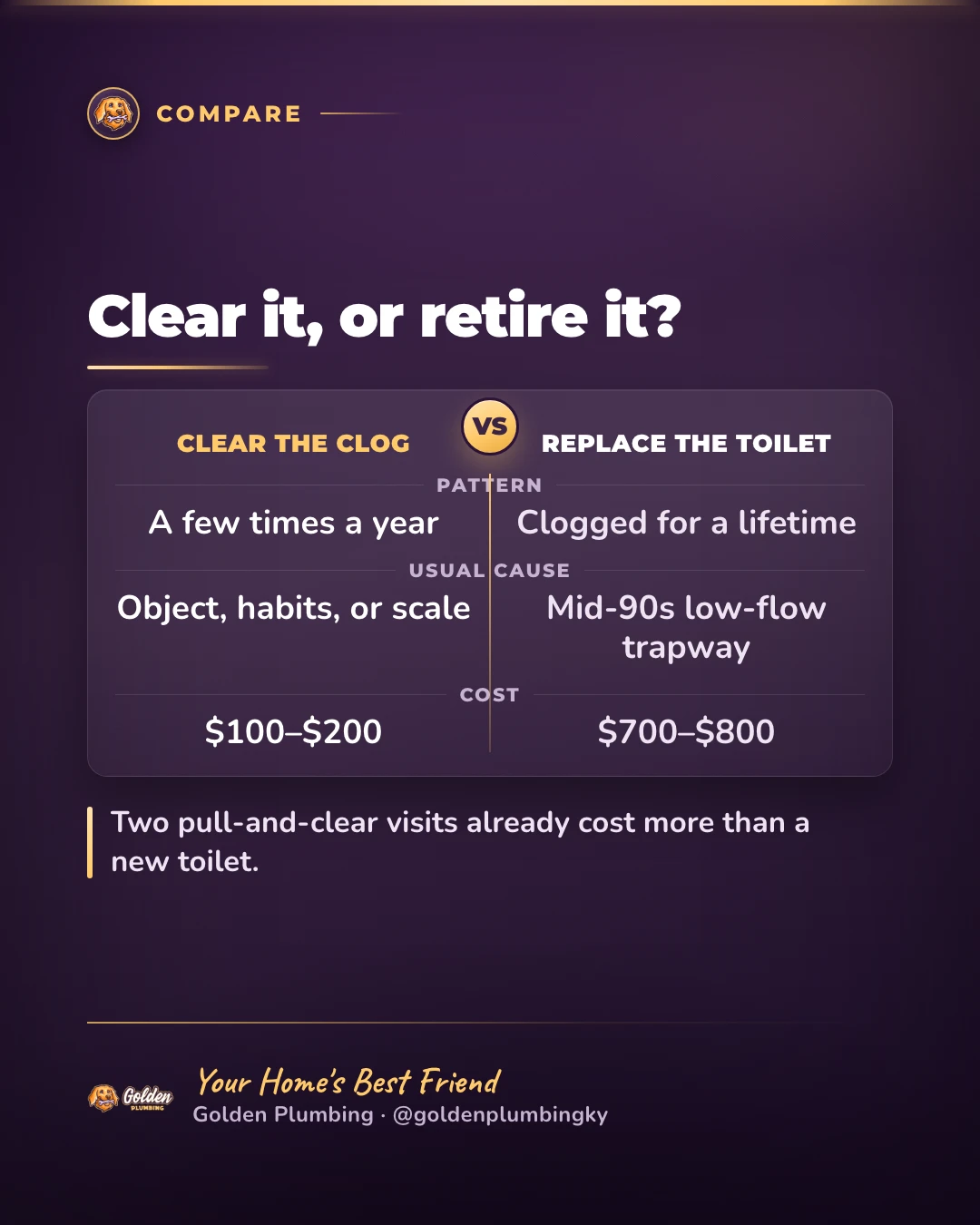
A toilet that clogs once ate something it shouldn’t have. A toilet that clogs every week has a standing reason, and there are really only four: something half-stuck in the trapway that snags paper, flushing habits the drain can’t digest, hard-water scale choking the jets that power the flush, or a first-generation low-flow toilet from the mid-90s that never flushed well on its best day. Clearing a blockage runs $100–$200. But if the same toilet needs clearing a few times a year, a modern replacement at $600–$800 installed usually costs less than another year of service calls, and it fixes the cause instead of the symptom.
There’s a plunger in some Louisville bathrooms that never gets put away. If that’s your bathroom, this one’s for you. A toilet that clogs once in a while just swallowed something it shouldn’t have. A toilet that clogs every week has a reason, because toilets don’t have moods. When one keeps backing up on completely normal use, something specific is wrong, it’s almost always findable, and about half the time the honest fix turns out to be a different toilet, not a better plunger. Here’s how to figure out which half you’re in.
The four reasons a toilet clogs over and over
It helps to know what a flush actually is. When you press the handle, the tank dumps its water into the bowl through the rim jets and the siphon jet, and that sudden rush starts a siphon in the S-shaped channel of porcelain behind the bowl called the trapway. The siphon is what does the pulling, not the water falling from the tank. It’s a chain reaction: enough water, moving fast enough, through a clear path that’s only about two inches wide. Weaken any link in that chain and the siphon never fully forms, the pull dies early, and paper stalls in the curve. That’s why a struggling toilet clogs on flushes a healthy toilet wouldn’t even notice.
- Something is half-stuck in the trapway The classic repeat offender. A kid’s toy, a floss pick, a clip-on bowl freshener that let go. It wedges in the trap without sealing it, so water still gets past and the toilet mostly works, but paper snags on it with every flush. The tell is that plunging always works but never lasts, because plunging clears the paper and leaves the object. The fix is getting the object out, sometimes with a toilet auger, often by pulling the toilet, clearing it, and resetting it on a fresh wax ring, which runs $400–$500.
- The household is flushing things that don’t break down Wipes marked flushable (they leave the bowl, they don’t break down), paper towels, cotton pads, heavy multi-fold paper habits. Toilet paper is engineered to fall apart in water. Almost nothing else in the bathroom is. If the clogs follow certain flushes or certain family members, this is your answer, and it’s free to fix.
- Hard water has choked the jets Louisville water runs hard, around 7 grains per gallon, and over years the mineral scales up the rim jets and siphon jet the same way it crusts a showerhead. The swirl gets lazy, the siphon forms late or not at all, and the flush leaves paper behind to build into a clog. If your bowl swirls weakly or the water rises before it goes down, read our piece on why a toilet flushes weakly, because a weak flush and a repeat clog are usually the same disease at different stages.
- The toilet is a mid-90s low-flow model If your toilet has clogged regularly for as long as you’ve owned the house, this deserves its own section, because a whole generation of toilets was built to clog. More on that next.
- One more to rule out: it isn’t the toilet at all If a tub gurgles when you flush or more than one fixture acts up, the blockage is downstream in the branch or main sewer line, and no toilet on earth will fix that. More on how to spot that below.
The mid-90s low-flow problem nobody warned you about
In 1994, a federal water standard took effect that dropped new toilets from 3.5 gallons a flush to 1.6. Good goal, rough rollout. Manufacturers didn’t have redesigned toilets ready, so the first generation of 1.6-gallon models was largely the old 3.5-gallon bowl and trapway designs running on less than half the water they were built around. They clogged constantly, people flushed twice out of self-defense, and low-flow toilets earned a reputation they’ve never fully shaken. If your house was built or remodeled in the mid-to-late 90s and still has its original toilets, you may own one of these, and no amount of plunging technique will change what it is.
Here’s the part that surprises people: the technology caught up, completely. Modern toilets have fully glazed, computer-designed trapways and engineered jets, and independent MaP testing now scores exactly how much each model can clear in one flush. A good 1.28-gallon toilet today flushes better than a 1996 toilet using more water. So low-flow was never the problem. First-generation low-flow was the problem.
Want to know if yours is one? Lift the tank lid. The manufacture date is stamped or molded into the porcelain inside the tank or on the underside of the lid. A date between 1994 and the late 90s, plus a lifetime of clogs, plus every other drain in the house behaving normally, is about as clear as a diagnosis gets. And for what it’s worth, a pre-1994 toilet running 3.5 gallons rarely clogs at all. It’s that middle generation that keeps the plunger business booming.
When it’s not the toilet at all
Before anyone sells you a new toilet, rule these out, because replacing porcelain won’t fix a pipe:
- Other drains join the party A gurgling tub, a bubbling floor drain, or two fixtures backing up together points at the main sewer line, not the toilet. In Louisville’s older neighborhoods that usually means tree roots in an old clay lateral. Clearing a main line through an existing cleanout runs $300–$400, and a camera inspection at $300–$400 settles what’s actually down there.
- It only happens during hard rain If your toilet backs up in a downpour and behaves the rest of the month, MSD’s combined sewers may be surcharging back through the low drains in your house. That looks exactly like a clog and isn’t one. Say so when you book, because it points the visit in a different direction.
- Every toilet in the house clogs Porcelain is rarely guilty in triplicate. When every toilet struggles, the cause is shared: flushing habits, or a line problem downstream of all of them. Fix the shared thing first.
What fixing it actually costs in Louisville
Here’s the honest money side. A standard diagnostic visit runs $89. Clearing a blockage from the bowl runs $100–$200. If something is lodged deep in the trap, pulling the toilet, clearing it, and resetting it on a fresh wax ring runs $400–$500, and that’s also the visit where we get to see the trapway directly and tell you what’s been catching all that paper.
Now the replacement math, because this is where repeat-clog toilets usually end up. A standard round toilet, supplied and installed, runs $600–$700, an elongated runs $700–$800, and comfort-height models run $800–$900. If you’d rather buy your own, the labor to install a customer-supplied toilet runs $300–$400. Two pull-and-clear visits cost more than a brand-new toilet, so if yours is a mid-90s original with a clog habit, the spreadsheet answers this one for you. Our rundown of the toilet brands that hold up covers what we’d actually put in our own homes, and the full installed-cost breakdown shows every option. If the evidence points downstream instead, budget $300–$400 to clear the main line and the same for a camera to see why it clogged. And if you just want the likely answer before anyone comes out, Ask Goldie will sort it in a couple of minutes.
Common questions we get
Why does my toilet clog even with normal toilet paper?
Because the flush is weak, not because the paper is strong. A healthy toilet clears normal paper use without drama, so when one can’t, either something is half-stuck in the trapway snagging paper, the jets are scaled up and the siphon never fully forms, or the toilet is an early low-flow design that never had enough flush to begin with. The pattern tells you which: a named flush that started it points to an object, a slow fade over years points to scale, and a lifetime of clogs points to the toilet itself.
Are flushable wipes actually flushable?
They’ll leave the bowl, which is all the label really promises. They don’t break down the way toilet paper does, and we pull rope-like wads of them out of trapways and sewer lines every month. If a toilet in your house clogs repeatedly and wipes are in the rotation, stop flushing them for two weeks and watch what happens. It’s the cheapest diagnosis in plumbing.
How do I find out how old my toilet is?
Lift the tank lid and look at the underside, then at the inside back wall of the tank. The manufacture date is stamped or molded into the porcelain. A date from 1994 through the late 90s puts your toilet in the first low-flow generation, the era with the deserved clogging reputation. Pair that date with a long clog history and you’ve likely found your culprit.
Will a new toilet really stop the clogs?
If the toilet is the culprit, yes, and dramatically. Modern toilets move waste that mid-90s models never could, and independent MaP testing proves it model by model. But if the real problem is downstream, a new toilet clogs exactly like the old one, which is why we check where the blockage actually lives before recommending replacement. Selling you porcelain to fix a root problem in the sewer line helps nobody, least of all you at the next backup.
Can you make an old low-flow toilet flush better without replacing it?
Sometimes, partway. Descaling the rim jets and siphon jet, setting the tank’s water level to the fill line, and replacing a lazy flapper can wake up a toilet whose flush faded over time. What none of that changes is the first-generation trapway design, so a true mid-90s clogger usually improves but doesn’t reform. On a toilet that needs clearing at $100–$200 a few times a year, we’ll tell you straight that the $600–$800 replacement is the cheaper toilet to own.
The next questions to ask
Tired of keeping the plunger on standby?
Ask Goldie figures out whether your toilet is fixable or one of the mid-90s clog machines, and prices both paths in a couple of minutes. Try it at goldenplumbingky.com/instant-estimate/