
LEARNING CENTER DRAINS
Why Your Washing Machine Drain Overflows (And What Actually Fixes It)
The short answer
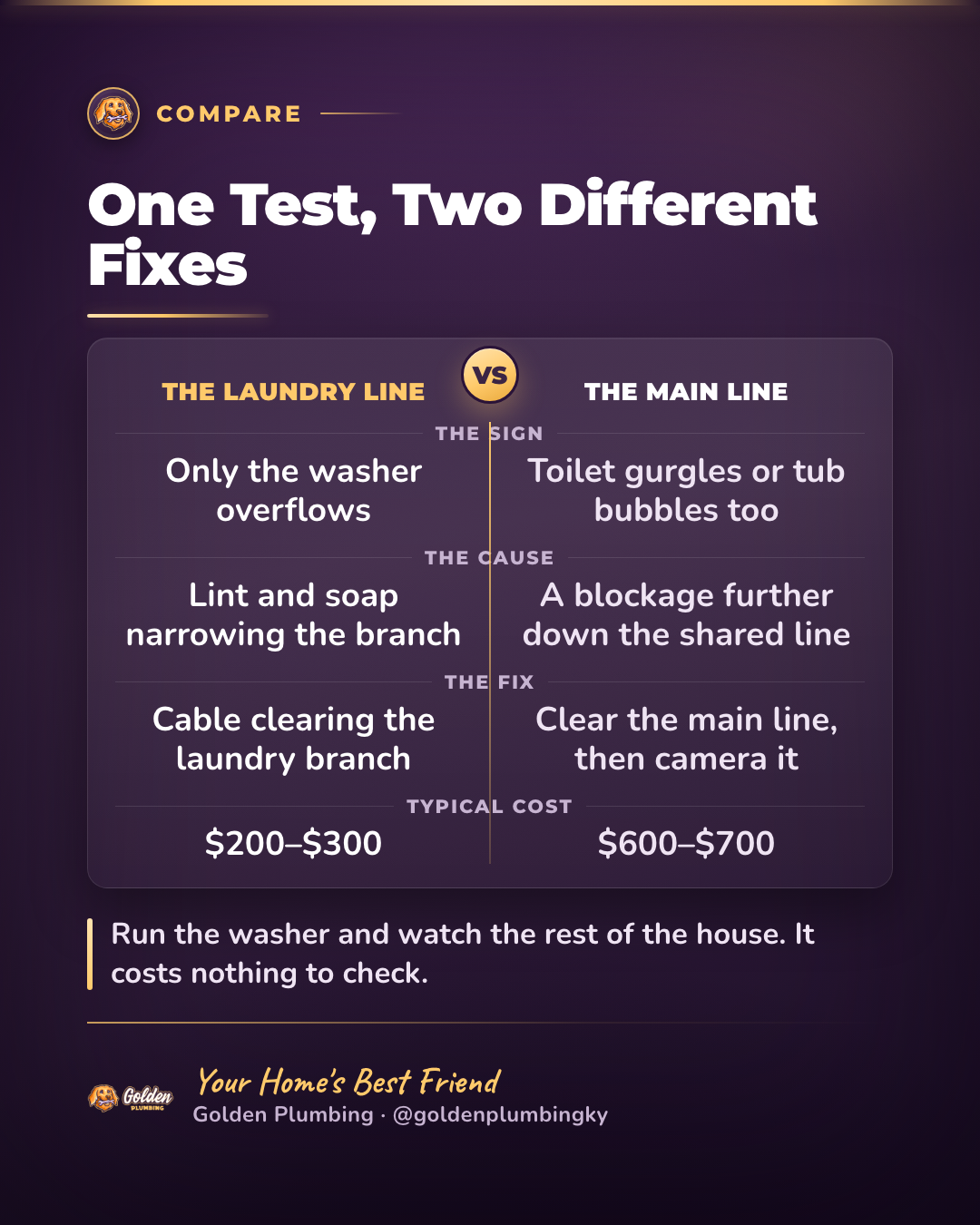
Nine times out of ten, that standpipe behind your washer is overflowing because lint, soap scum, and fabric fibers have narrowed the drain line until it can’t carry the water away fast enough. Clearing a laundry drain runs $200–$300. Newer high-efficiency washers make it worse because they pump out a fast, heavy burst instead of a slow trickle, so a line that drained an old top-loader just fine for years suddenly can’t keep up. If other drains in the house are also acting up when the washer runs, or a toilet gurgles on the drain cycle, the real problem is downstream in the main line, not the laundry hookup, and that’s a different fix. One quick test tells you which one you’ve got, and it costs nothing.
We get this call constantly in Louisville, usually described the same way: the washer hits its drain cycle, and a minute later there’s water creeping across the laundry room floor. It looks alarming the first time it happens, especially if it’s soaking a finished basement, but it’s almost always one narrow pipe losing a fight with more water than it can carry. Here’s what’s actually going on back there, what you can check yourself, and when it’s genuinely a bigger problem than a dirty drain line.
What’s actually happening behind your washer
The pipe sticking up out of the wall or floor behind your washer is called a standpipe. The drain hose hooks over its open top with a gap of air between them (that gap is code, not an accident, and it’s what keeps dirty drain water from ever siphoning back into your clean laundry water). Below that, the standpipe ties into a trap, then a branch line, then eventually the main line that carries everything out of the house.
When it works right, the washer pumps out water in a hard, fast burst that drops down the standpipe and clears before the next burst comes. When it overflows, water is arriving at the top faster than it’s leaving the bottom. That sorts into two different problems: something narrowing the laundry line itself, or something wrong further downstream.
The most common cause: lint, soap, and fabric fiber buildup
- Lint and fabric fiber caking the pipe walls Every wash cycle sends lint, thread, and pet hair down that standpipe, and unlike your dryer, there’s no lint trap catching it. Over the years it sticks to the walls, especially at the trap and first bend, and the channel gets narrower. A pipe that handled a burst fine when the house was new can choke on the same burst ten years later.
- Soap and detergent residue hardening into scale Detergent, fabric softener, and Louisville’s hard water combine into a gritty film that clings to lint instead of rinsing clean, turning loose fuzz into a crust a garden hose can’t touch. That’s why a standard laundry-drain clearing runs $200–$300 rather than a simple snake-and-done.
- A high-efficiency washer pumping faster than the old line was built for This isn’t a clog at all. Older top-loaders drained in a long, gentle trickle; newer high-efficiency machines discharge in a shorter, harder burst. An older, narrower branch, especially the 1.5-inch line common in Louisville homes built before the 2000s, can outpace even a perfectly clean pipe. Same house, same drain, brand-new washer, sudden overflow. That’s usually the tell.
- The standpipe itself being too short, too narrow, or trapped wrong Too short and a fast burst can’t clear the bend below it in time; too narrow and it can’t hold a full burst while it drains. A DIY or pre-code hookup can be the root cause even when everything downstream is spotless.
When it’s actually the vent, not the drain
Every drain needs a vent, a separate pipe that lets air into the system so water can flow out freely, the same way a second hole in a milk jug lets it pour instead of glugging. If the laundry line’s vent is blocked, undersized, or never properly tied in, the draining water has to fight negative pressure. The tell is a gurgling or glugging sound from the standpipe on top of the slow draining. Cleaning the line does nothing here, since the pipe isn’t actually blocked. On a line that can’t reach an existing vent stack, installing an air admittance valve, a small mechanical vent that opens to let air in and seals against sewer gas, runs $300–$400 and fixes it without opening a wall.
Is it really a main line problem?
Here’s the test that matters most, and it costs you nothing: run the washer’s drain cycle and watch the rest of the house. If the laundry standpipe is the only thing acting up, the problem lives in the laundry line. If other fixtures react at the same time, the problem is downstream of the laundry hookup, in the main line everything shares, and the laundry is simply the first place you notice it because it dumps the most water the fastest.
- Only the standpipe overflows Nothing else in the house is affected, no matter when you run the washer. That points squarely at the laundry branch line, whether it’s buildup, a flow mismatch, or a vent issue.
- A toilet gurgles or a tub bubbles when the washer drains That cross-talk means the washer’s burst has nowhere to go and is pushing air back up the shared line into other traps, an early warning the main line is narrowing.
- A basement floor drain backs up during the wash cycle The floor drain is usually the lowest opening in the house, so a struggling main line shows itself there first. The washer’s big, fast dump of water is exposing a main line that’s already partly blocked.
- More than one fixture is affected at once Toilet, tub, and laundry all acting up together is never a coincidence. That’s the main line, and it needs to be addressed there, not at the washer.
What you can check yourself vs. what needs a pro
- Check: the lint filter and hose, if your washer has one Some washers have an internal lint trap or a small inline filter on the drain hose. That’s a five-minute, zero-cost check worth ruling out first.
- Check: whether it only happens on heavy or bulky loads Overflowing only on towels or bedding, not a normal wash, points toward the line being right at its limit. Smaller, more frequent loads are a real stopgap while you plan the fix.
- Check: the pattern from the section above Running that quick test, washer alone versus washer plus other fixtures, is the single most useful thing you can do before calling anyone.
- Call us: for anything past the standpipe itself Clearing lint and soap buildup out of a laundry branch line needs a cable machine sized for that pipe, not a store-bought hand auger, which mostly just pushes the clog around. If it’s a vent or main line issue, that’s not a DIY repair. A standard diagnostic visit runs $89 and tells you exactly what you’re dealing with.
Louisville specifics worth knowing
A few local details change how this plays out here more than in other places:
- Older Louisville homes often run undersized or cast-iron laundry branch lines Homes built before the 2000s frequently have a 1.5-inch laundry branch instead of today’s 2-inch minimum, and may still run that branch in cast iron, which narrows further as it corrodes and scales. Both worsen the flow-rate mismatch with a new high-efficiency washer.
- MSD owns the main, you own everything on your side of it MSD is responsible for the public sewer main in the street. Everything from your standpipe through the private lateral, including the laundry branch, is the homeowner’s to maintain.
- It keeps coming back? Ask for a camera, not another clearing If the same standpipe overflows again within a few months, snaking it a third time just rents you time. A camera inspection runs $300–$400 and shows exactly what’s narrowing the line, whether it’s scale that needs jetting instead of cabling or something else worth knowing about.
What the fixes cost in Louisville
A standard laundry-drain clearing, the fix for straightforward lint and soap buildup, runs $200–$300. If the line needs the full commercial electric snake because the buildup is deeper or the run is longer, that’s $300–$400. For scale that keeps coming back after a standard cable clearing, a mini-jetter that scours the pipe clean with pressurized water runs $400–$500 and tends to hold up longer. If it’s venting rather than a clog, an air admittance valve runs $300–$400. If the test above points to the main line, clearing it through an existing outside cleanout runs $300–$400, or $500–$600 if we need to create access and evaluate with a camera. A diagnostic visit to sort out which of these you’re facing is $89, and $199 after hours if it can’t wait for morning.
Common questions we get
I just got a new washer and now the drain overflows. Is the washer broken?
Almost never. A new washer pumping water out faster than an old line was designed to carry is one of the most common causes we see, especially with high-efficiency models replacing an older top-loader. The washer is doing what it’s supposed to; the pipe is the bottleneck. Clearing built-up lint and soap residue often buys enough capacity, and if it doesn’t, the line itself may need a look.
Can I just run a drain cleaner down the standpipe?
We’d skip it. Chemical drain cleaners are built for grease and hair, not the felted mat of lint and detergent scale that clogs a laundry line, so they rarely clear it and can sit corroding an older pipe instead. A cable sized for that branch, or a mini-jetter for hardened buildup, actually removes what’s in there.
Why does my toilet gurgle when the washer drains?
That’s the washer’s fast burst pushing air back up the shared drain line into the toilet’s trap, meaning the water didn’t have a clear path downstream. It’s one of the clearest signs the real problem is the main line, not the laundry hookup.
How do I stop this from happening again?
Clean out any lint filter your washer has, and if the line has never been cleared, get it done before it becomes a repeat problem. On an older Louisville home with a narrow or cast-iron branch, ask about upsizing the line during any other laundry-room work.
The next questions to ask
Water on the laundry room floor every time the washer drains?
Ask Goldie walks you through it in a couple of minutes and tells you whether it’s the laundry line or something further downstream. Try it at goldenplumbingky.com/instant-estimate/