
LEARNING CENTER SUMP & DRAINAGE
Do you need a backwater valve for your Louisville basement? (The honest answer)
The short answer
Honest answer: not every Louisville basement needs a backwater valve, but a specific group of homes genuinely do. It’s the fix for sewage backing up through your lowest drain when the city sewer itself gets overwhelmed, not a general basement-flooding cure. You’re a strong candidate if sewage has already come up a floor drain or basement fixture once, if your basement has a floor drain, laundry standpipe, or bathroom sitting below street level, or if you’re in an older Louisville neighborhood on a combined sewer system. If your basement has never backed up and nothing down there sits below the trouble point, you can reasonably wait. And if the water you’re actually fighting is groundwater rather than sewage, a backwater valve won’t touch it at all. That’s a sump pump’s job.
This is one of those questions where the easy sales pitch is ‘everyone should have one, better safe than sorry.’ We’re not going to tell you that, because plenty of Louisville homes go their whole life without a drop of sewage ever reaching the basement, and a valve on their line would’ve been money spent guarding against something that was never going to happen to them. Other homes, especially certain neighborhoods and certain floor plans, are genuinely one hard storm away from a mess nobody wants to mop up twice. So let’s sort out what this thing actually protects against, who’s really in the risk group, and who can fairly skip it.
What a backwater valve actually stops
Your home’s sewer lateral is a one-way street by design. Wastewater leaves the house, runs downhill under your yard, and joins the city main out at the street. A backwater valve sits inline on that lateral, usually wherever it’s easiest to reach: the basement floor near the foundation, or a small access box out in the yard. Inside it is a hinged gate that hangs open under normal flow and doesn’t do a thing to the water leaving your house. The valve only earns its keep on the rare day the city sewer itself gets overwhelmed, usually during a heavy storm, and water tries to reverse course back up your lateral instead of away from it. That reversal is what lifts the gate shut. Wastewater that would’ve surged up through your lowest drain stops at the valve instead, out in the yard or under the slab, not on your basement floor.
Who’s a strong candidate for one
- You’ve already had a sewage backup Once is usually enough to make the decision for you. If sewage has ever come up a floor drain, a basement toilet, or a laundry standpipe, you already know what the alternative to a valve looks like, and it’s worth every bit of the cost to make sure it doesn’t happen twice.
- Your basement has a floor drain, laundry standpipe, or bathroom below street level Those are the low points a surcharging sewer finds first. A finished basement with a bathroom down there, or even just an unfinished one with a floor drain and a washer standpipe, is exactly the setup a backwater valve is built to protect.
- You’re in an older Louisville neighborhood on a combined sewer A lot of Louisville’s older neighborhoods still run combined sewers, where stormwater and sewage share the same pipe. During a hard rain the system can fill faster than it can carry the flow away, and that’s when it pushes back toward the lowest opening it can find, which is often somebody’s basement drain.
- You’ve got real stuff at risk down there A finished basement, a home office, a workshop full of tools, or anything you’d hate to see ruined twice raises the stakes of doing nothing. A backwater valve is cheap insurance against exactly that kind of loss.
Who can reasonably skip it
We’d rather tell you when the money’s better spent elsewhere. You’re a fair candidate to wait if:
- You’ve never had a backup, and your basement sits above the trouble point No floor drain, no low fixtures, nothing below street grade a surcharging sewer could reach. If sewage has never once come up and there’s nowhere for it to come up into, there’s no urgent case for a valve.
- You’re in a newer development on separated storm and sanitary lines Newer subdivisions built with storm sewers kept apart from the sanitary line don’t carry the same combined-sewer surcharge risk that drives most Louisville backups. Worth confirming for your street specifically, but it changes the math.
- You’re renting A backwater valve is plumbed into the house itself. That’s a landlord’s call and a landlord’s expense, not something a tenant should be paying to install.
- Your actual problem is groundwater, not sewage Water rising clean and clear in a sump pit, rather than dirty water coming up a drain, is a sump pump problem. A backwater valve does nothing for that, and spending on one instead of fixing the actual pump just wastes the money.
What it won’t fix
It’s worth being straight about the limits, because a backwater valve sometimes gets sold as a cure-all for a wet basement, and it isn’t one. It only stops sewage trying to flow backward into your house. It does nothing for groundwater rising around your foundation or a failed sump pump, and it does nothing for storm water coming in through a window well or a crack in the wall. If your basement floods with clean water during a rainstorm and the sump pit is dry, you need a working sump pump, not a backwater valve. The two systems solve two different problems, and a basement that floods for both reasons genuinely needs both.
How we’d approach it
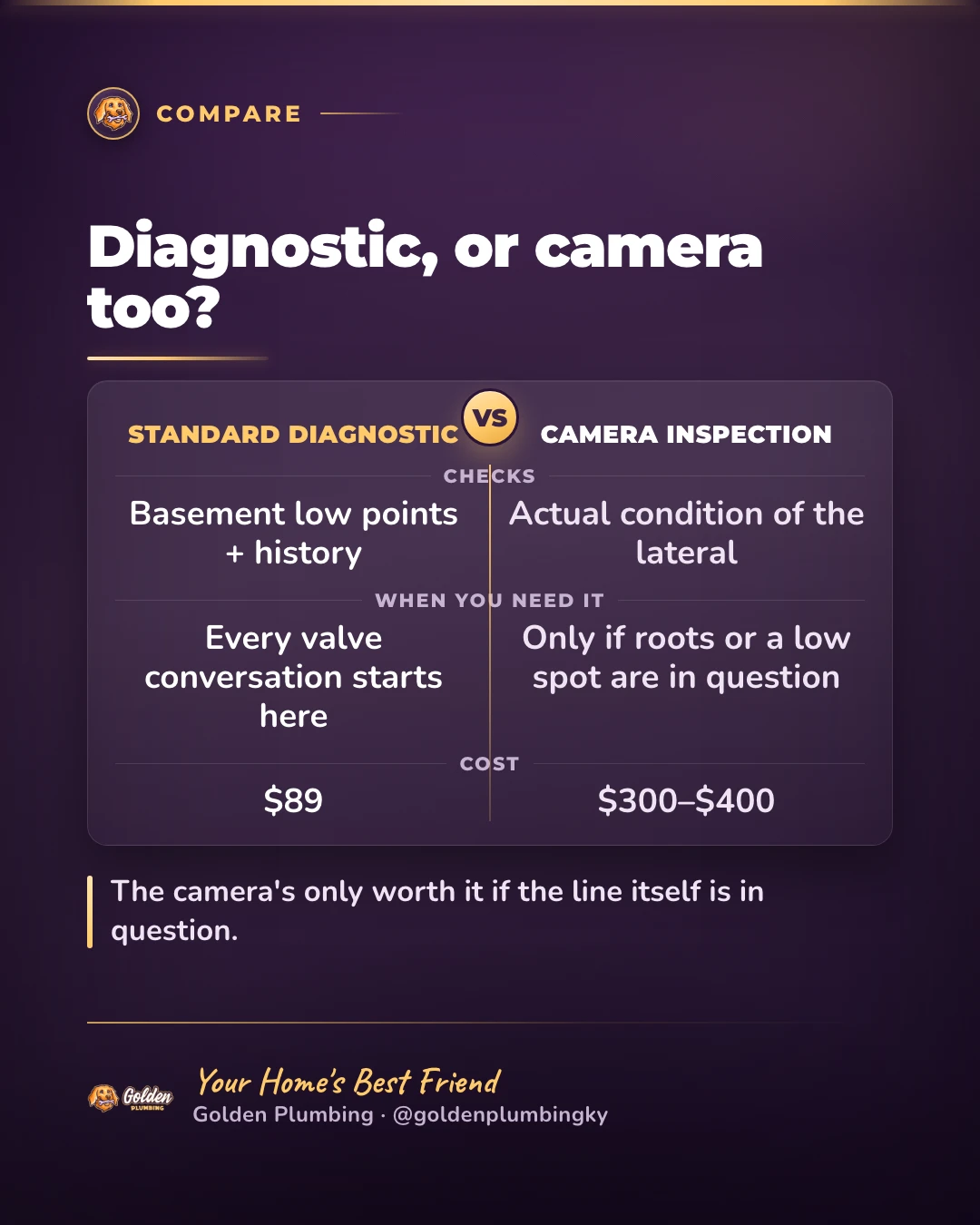
The first visit is a standard diagnostic, $89, where we walk the basement, find your low points, and talk through whether your neighborhood and history put you in the candidate group above. If there’s any question about the condition of your lateral itself, whether roots or a low spot in the line are already part of the story, a camera inspection runs $300–$400 and tells us exactly what we’re working with before anyone opens anything up. Installing the valve itself comes down to where it makes sense to sit: inside the basement floor near the foundation is usually the least disruptive spot when there’s room for it, while a yard-box install on the lateral itself is a bigger dig. Either way, altering the sewer line is the kind of work Kentucky’s Division of Plumbing requires a permit for, scoped to the actual job rather than a flat fee. Because the install price swings so much on where the valve goes and what the camera finds first, we’re not going to put a made-up number on it here. What we will do is give you a straight one after we’ve actually seen your basement and your line, not a guess over the phone. Want a sense of where you’d land before anyone comes out? Ask Goldie can walk you through it, and if you’re weighing a valve against a sewer line repair at the same time, we’ll tell you honestly which one your situation actually calls for.
Common questions we get
Is a backwater valve the same thing as a sump pump?
No, and mixing them up is the most common mistake we see. A sump pump handles groundwater collecting around your foundation and pumps it away. A backwater valve handles sewage trying to flow backward into your house when the city sewer surcharges. A wet basement can need either one, or both, depending on where the water’s actually coming from.
How do I know if my sewer is combined or separated?
As a rule of thumb, older Louisville neighborhoods are more likely to run combined sewers, where storm and sanitary flow share one pipe, and newer developments tend to be built with the two kept separate. It’s not a hard rule for every street, so the honest answer is we can check it for your address when we’re out.
Does a backwater valve need maintenance?
Yes, though not much. The gate mechanism should get checked periodically to make sure it still swings freely and seals when it needs to. A valve nobody’s looked at in years is exactly the kind that fails quietly, right when a storm finally puts it to the test.
Will a backwater valve lower my home insurance?
Sometimes, depending on your carrier and your policy, especially if you’ve already filed a sewer-backup claim. Ask your agent directly. We’re plumbers, not adjusters, but it’s a fair question to raise once the valve’s in.
Can I install a backwater valve myself?
We wouldn’t recommend it. It goes inline on your sewer lateral, which in Kentucky is work that needs a permit, and getting the slope and the access point wrong defeats the whole purpose of having one. This is a job where the install matters as much as the part.
The next questions to ask
Not sure if a backwater valve makes sense for your basement?
Ask Goldie walks you through your setup and your neighborhood in a couple of minutes and tells you honestly whether it’s worth it. Try it at goldenplumbingky.com/instant-estimate/