
LEARNING CENTER · Drains
Why won't my bathtub drain? (Hair at the stopper, the tub shoe, and when it's not the tub at all)
The short answer
Most of the time, a bathtub that drains slow or not at all is hair and soap scum caught at the strainer and the trap arm behind it, and clearing that runs $200–$300. But not always. The trip lever or the plunger-style stopper up inside the overflow tube can slide out of adjustment and choke the drain even with no clog, and older Louisville tubs sometimes run a corroded tub shoe or a drum trap a store-bought snake can't get past. The tell that it isn't the tub at all: if the toilet gurgles or the lowest drain backs up when the tub empties, the problem is downstream in the main line. Most bathtub drain problems are a small job, not a big one.
A bathtub that won't drain is one of the most common calls we get in Louisville, and it's usually not what people fear. Tub language showed up in about one out of every fifteen jobs we closed recently, and most were a straightforward clog, not an emergency. Here's what's actually happening down there, what's safe to try yourself, and how to spot the rare case that's bigger than a clogged tub.
What's actually going on behind the drain
A bathtub actually runs two separate drain paths that meet at the bottom. Up top, the overflow plate connects to a trip lever or a plunger-style stopper riding inside a vertical tube behind the wall, sealing the drain shut when it's down and lifting clear when it's up. Down at the tub floor, the strainer opens into a trap arm, a short run of pipe curving down to the tub shoe (or the full waste and overflow assembly on older tubs), then into the branch line toward the main.
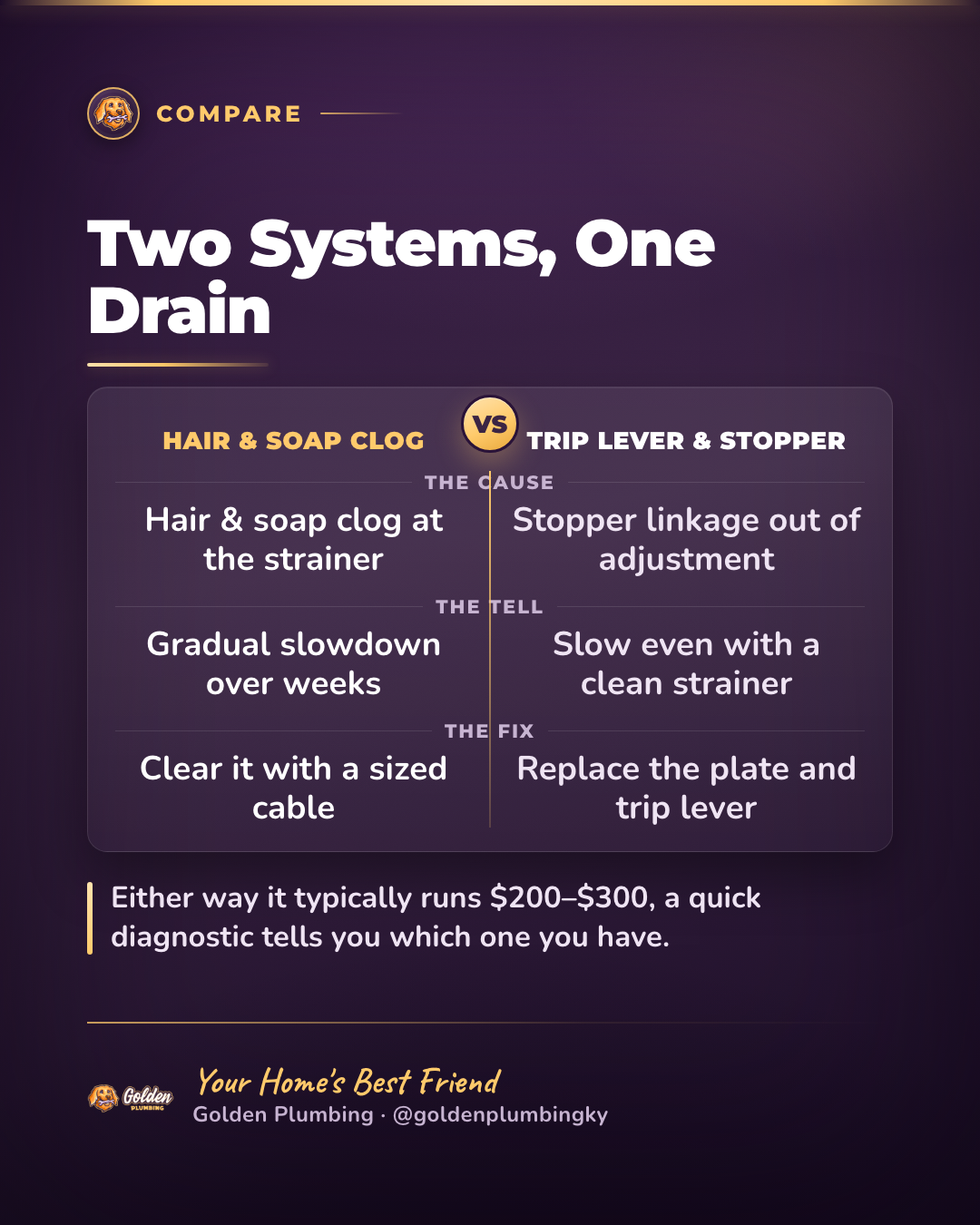
Almost always the cause is the lower path: hair and soap scum physically blocking the flow. Sometimes it's the upper one, no clog anywhere, just a stopper that isn't opening all the way. Knowing which saves you from cleaning a drain that was never actually blocked.
The most common cause: hair and soap scum
- Hair and soap scum caught at the strainer and the trap arm This is the story behind most tub calls we run. Hair catches on the strainer or just past it, and soap scum binds to it instead of rinsing through, building a mat that narrows the opening with every shower. Clearing that runs $200–$300.
- Louisville's hard water makes the scum worse Our water runs about 7 grains per gallon, hard enough that soap leaves a gritty film that clings to hair like glue. That's why a Louisville tub drain re-clogs faster than generic online advice expects.
- It's usually gradual, not sudden A tub that's slowed over weeks or months points straight at buildup. A sudden, total stop after one event, a toy, a washcloth, a big clump of hair, is worth checking by hand first, since that one's often a quick fix.
When there's no clog at all: the trip lever and the stopper in the tube
Here's the one that surprises people. Plenty of tubs use a trip lever on the overflow plate, linked to a plunger-style stopper that hangs inside the overflow tube itself, not a rubber stopper you can see and pull at the bottom. When that linkage slips out of adjustment, corrodes, or the plunger sits a little too low, it partially blocks the drain even though nothing is actually clogged. You'll notice a tub that drains slow no matter how clean the strainer looks. Replacing the overflow plate and trip lever runs $200–$300, and it's a genuinely small job, not a sign anything is wrong with your drain line.
Older Louisville tubs: the tub shoe and drum traps
Pre-war Highlands, Germantown, and Schnitzelburg housing stock often still runs cast-iron tub waste lines. Cast iron corrodes on the inside over the decades, and that rough, pitted interior snags hair far more aggressively than smooth modern pipe, so the same amount of hair causes a worse clog in an older tub. The tub shoe, the fitting connecting the drain to the trap below the floor, corrodes right along with it; replacing a leaking or badly scaled one runs $400–$500. If more of the assembly, trip lever, overflow plate, and strainer together, needs to come out at once, replacing the whole waste and overflow mechanism runs $900–$1,000.
Some very old tubs go a step further and run a drum trap, a squat cylindrical trap set into the floor instead of today's P-trap shape. A standard consumer snake can't make the turn through one, which is why a tub that "should have cleared" sometimes doesn't. When we suspect that's what we're dealing with, a mini camera inspection sized for branch lines runs $300–$400 and tells us exactly what's down there first.
Louisville specifics worth knowing
A few local details change how this plays out here:
- Hard water, roughly 7 grains per gallon It turns ordinary soap scum into a stickier, faster-forming buildup, the single biggest reason a Louisville tub clog returns sooner than generic online advice assumes.
- Older neighborhoods often mean cast-iron tub waste lines Pre-war housing stock in the Highlands, Germantown, and Schnitzelburg frequently still runs original cast-iron waste lines, which corrode internally and snag hair worse than smooth modern pipe.
- Very old tubs may run a drum trap A drum trap won't let a standard hand snake pass through, one reason a DIY attempt sometimes goes nowhere on an older home even when the clog is nothing unusual.
Gurgling or glugging as it drains? That's venting, not a clog
If the tub gurgles or glugs on top of draining slow, that's usually a sign the line isn't getting enough air, not that it's blocked. Every drain needs a vent so water can flow out freely, and clearing the strainer or trap arm won't fix that, since there's nothing physically in the way. We cover it in more depth in our guide to why drains gurgle.
When it's not the tub at all
Here's the test that matters, and it costs nothing: run the tub's drain and watch the rest of the house. If the tub alone is slow and everything else drains normally, the problem lives in the tub. If the toilet gurgles, another fixture bubbles, or the lowest drain backs up at the same time the tub is emptying, the problem is downstream in the main line everything shares, and the tub is just where you notice it first. That's a different conversation, covered in our guides on toilet clog vs. main sewer line and, if this keeps happening, why a drain keeps clogging.
What's safe to try yourself
- Pull the stopper and clean it by hand Most tub strainers and pop-up stoppers lift or unscrew out with a little effort. Nine times out of ten there's a visible hair mat wrapped right around it, and pulling it out by hand solves the problem on the spot, at no cost.
- Use a plastic barbed hair-removal tool These cheap, flexible plastic tools with backward-facing barbs are built for exactly this job. Feed one down past the strainer, twist, and pull, and it drags out hair your hand can't reach. Safe for any tub, any age.
- Boiling water and dish soap for a soap-scum slowdown If the tub is just slow, not fully stopped, a kettle of boiling water with a squirt of dish soap can loosen soap scum enough to get you back to normal flow. It won't touch a real hair mat, but it's worth trying first.
- Skip the chemical drain opener We don't recommend chemical drain cleaners in a tub. They tend to sit on top of a hair mat instead of dissolving it, so you're often left with the same clog plus caustic water in the tub. On an older cast-iron line, repeated use speeds up the corrosion already working against you and can damage the finish. It also makes the drain genuinely dangerous for the next person who opens it, including us.
What the fixes cost in Louisville
For the common case, hair and soap scum at the strainer and trap arm, clearing the tub drain with a properly sized cable runs $200–$300. If the clog sits further down the branch line than the trap arm reaches, clearing that longer run is $200–$300 as well. If it's the trip lever and stopper mechanism rather than a clog, replacing it runs $200–$300. On older tubs, a corroded tub shoe replacement runs $400–$500, and the full waste and overflow assembly is $900–$1,000. If we suspect a drum trap and want eyes on it first, a mini camera inspection runs $300–$400. Not sure which you're facing? A standard diagnostic visit is $89 and gets you a straight answer first.
Common questions we get
Why does my bathtub drain slowly even after I clean the stopper?
The buildup is likely further down in the trap arm where you can't reach it, or the trip lever and overflow stopper mechanism is misadjusted and blocking flow with no clog present. A diagnostic visit tells you which one you've got before you pay for the wrong fix.
Is it safe to use a chemical drain cleaner in my bathtub?
We'd skip it. Chemical openers are built for grease, not the felted hair and soap mat that clogs a tub, so they often just sit on top of it. On an older cast-iron line they speed up corrosion, they can damage the finish, and they leave caustic water for whoever opens the drain next. A hand tool or a properly sized cable actually removes the clog.
Why does my toilet gurgle when my bathtub drains?
That's the tub's water pushing air back up a shared drain line because it doesn't have a clear path downstream. It's one of the clearest signs the real problem is the main line, not the tub, and it's worth a look rather than clearing the tub again.
What's a drum trap, and why does it matter for my old tub?
A drum trap is a squat cylindrical trap set into the floor, used in older plumbing instead of today's P-trap shape. A standard hand snake can't make the turn through one, which is why a DIY attempt on an old Louisville tub sometimes goes nowhere on an ordinary clog. A camera or a properly sized cable gets past it.
The next questions to ask
Bathtub draining slow or not at all?
Ask Goldie walks you through what's likely causing it and gives you a real price in a couple of minutes. Try it at goldenplumbingky.com/instant-estimate/