
LEARNING CENTER SUMP & DRAINAGE
Does insurance cover sewer backups and basement flooding? The honest answer (usually no, unless you add this)
The short answer
Usually, no. A standard homeowners policy pays for sudden, accidental water damage from something inside your own plumbing, like a burst pipe or a water heater that lets go. It doesn’t pay when a sewer or drain backs up, and it doesn’t pay when water gets in from outside the foundation. Those are both standard exclusions on nearly every policy written. The fix for the first one is a separate add-on, usually called water backup or sewer and drain backup coverage, and you have to specifically ask your agent for it and pay a little extra. It typically covers drying out and rebuilding what got wet. It usually doesn’t cover fixing the pipe, the roots, or the pump that caused the backup in the first place, so budget for that repair separately no matter what your policy says.
Nobody thinks about their homeowners policy until there’s sewage standing on the basement floor. Then the claim comes back denied, or covered for a fraction of what people expected, and the frustration that follows usually isn’t really about us or the insurance company. It’s about not knowing the rules before the water showed up. We’re plumbers, not insurance agents, and we won’t pretend to be the last word on your specific policy. But we see the aftermath of this exact surprise often enough in Louisville basements that the pattern is worth laying out plainly, before you’re the one holding a mop and a claim number.
What a standard policy actually covers
Almost every homeowners policy draws the same three-way line, even though the wording varies by carrier. Water damage that’s sudden and accidental, coming from inside your own plumbing, a burst supply line, a water heater that ruptures, a washing machine hose that lets go, is the kind insurers built the policy to cover. Water that backs up through a sewer, a drain, or a sump pump is carved out as a specific exclusion on nearly every standard form. And water that gets in from outside the house, storm runoff, rising groundwater, a window well that fills up, isn’t plumbing damage at all in the policy’s eyes, and it’s excluded too. Same wet basement, three different categories, and only one of them is covered by the policy you probably already have.
Why the sewer exclusion catches so many Louisville homeowners off guard
The exclusion exists because a backup isn’t always your fault, and insurers don’t want to be on the hook for a city sewer system’s bad day. Louisville’s MSD runs a combined sewer system through a lot of the older parts of town, with 111 active combined-sewer-overflow locations that average around 30 overflows a year. During a heavy storm, that system can get overwhelmed and push water backward through the lowest opening it can find, which is very often a basement floor drain. That’s not a burst pipe, and it’s not something you caused. It also isn’t covered by a standard policy, because from the insurer’s side it’s a backup, not a discharge. People assume a policy that covers water damage covers all water damage. It doesn’t, and finding that out after the water is already on the floor is the worst possible time to learn it.
The endorsement that changes the answer
What restores coverage is a specific add-on, usually named something like water backup coverage or sewer and drain backup coverage, sometimes bundled with sump pump overflow. It isn’t automatic. You have to ask your agent for it, and you pick a coverage limit when you buy it, which is worth doing thoughtfully if your basement is finished rather than a storage room. Here’s the part that’s easy to miss: the endorsement pays for the damage the backup caused, drying out the space, replacing ruined drywall and flooring, dealing with damaged contents, up to whatever limit you chose. It generally doesn’t pay to fix whatever actually caused the backup. If roots in an old clay lateral pushed the water back into your house, the endorsement helps with the mess. It doesn’t cut the roots out of your line. That repair is still a plumbing bill, and it’s still coming whether or not you had the coverage.
What actually lowers your risk, whatever your policy says
None of this is fixed in a single afternoon, but a few things move the needle either way:
- Find out why it happened before you argue with anyone A camera inspection runs $300–$400 and shows you exactly what’s going on in the line, roots, a bellied section, or nothing wrong with your line at all, which points the finger back at the city system during a storm. That answer matters for the insurance conversation too, since “the city sewer backed up in a flood event” and “your own line is failing” can land very differently with a claim.
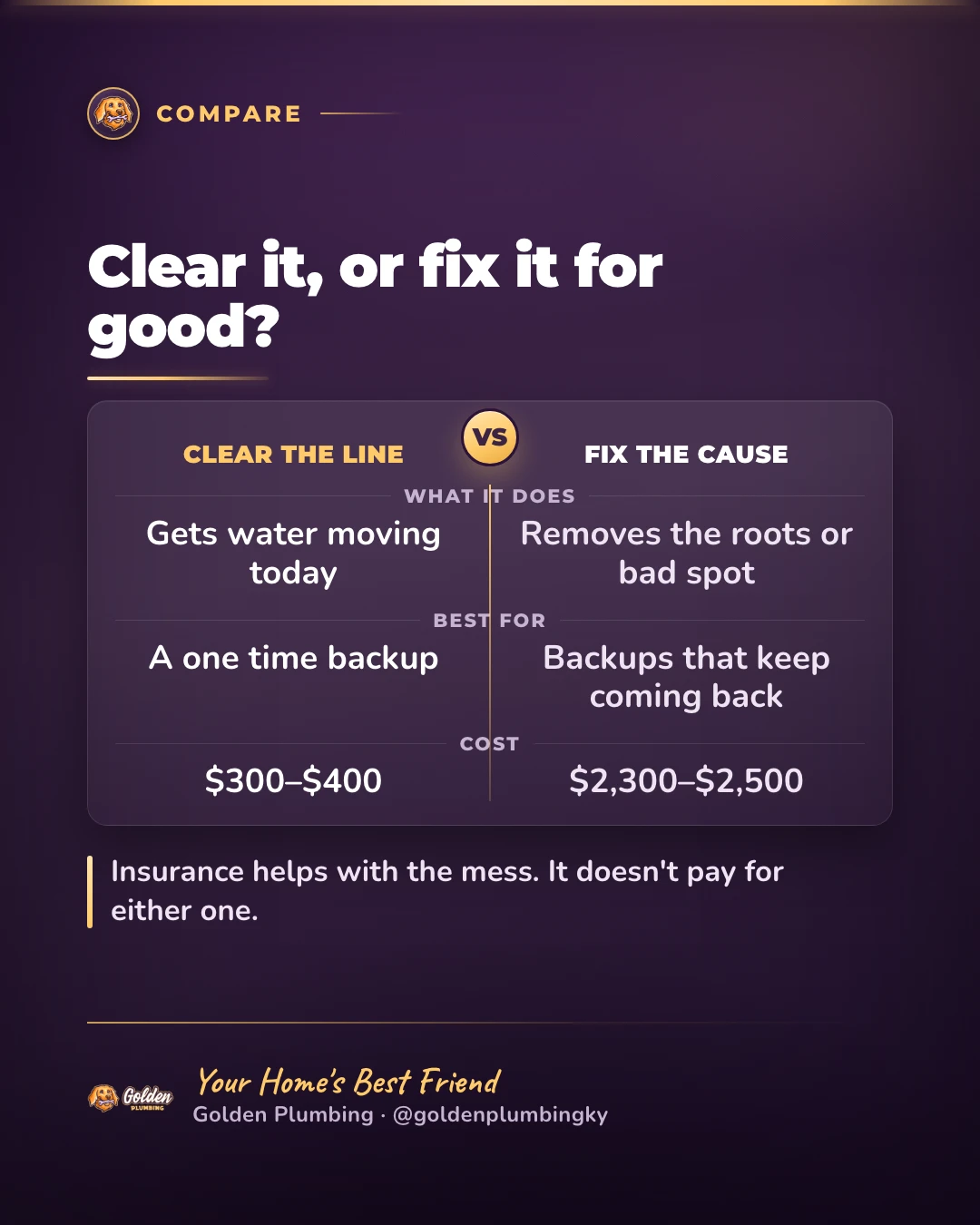
- Clear it, then decide on the real fix Clearing the main line through an existing cleanout runs $300–$400 and gets water moving again today. If the camera shows roots or a sagging section behind it, a low-intrusion spot repair on the trouble spot runs $2,000–$2,200, which is real money, and it’s the piece your insurance almost certainly won’t touch.
- Ask about a backwater valve A backwater valve installs in your main line and closes automatically when city sewage tries to flow backward toward your house, so it keeps a municipal surge from ever reaching your basement in the first place. It’s the most direct answer to “how do I stop this from happening again” when the cause is the city system rather than your own line. Access and line size change the job, so we’ll price it for your specific setup when we’re out rather than guess at a number here.
- If it’s the sump pump, not the sewer, that’s a different conversation A pump that mechanically fails, rather than a true sewage backup, is often exactly what a water backup and sump overflow endorsement is built for. A standard sump pump replacement with a new check valve runs $800–$900, and if losing power during a storm is the real risk at your house, a battery backup sump pump runs $2,000–$2,200. Cheaper than a flooded finished basement, and worth mentioning to your agent either way.
Who to call first
The order matters more than people expect, and getting it backward costs time on a claim:
- Water is on the floor right now Call us first if you’re not sure whether this is a sewer backup, a pump failure, or storm water coming in from outside, because the source changes what you tell your insurer. Call your agent once you know what actually happened. Photos before cleanup, every time.
- You’re planning ahead and nothing’s flooded yet Call your agent first. Whether you already have a water backup endorsement, what limit it carries, and whether you need separate flood insurance are all questions we genuinely can’t answer for you. We can tell you whether your line and pump are a real risk; your agent tells you what’s actually covered.
- You already got a denial letter That’s between you and your carrier, and we’re not going to second-guess an adjuster we’ve never talked to. What we can do is give you a straight camera inspection and an honest read on why the backup happened, which is useful either for an appeal or for deciding what to fix so it doesn’t happen again.
None of this is a reason to skip a diagnostic visit while you sort out the insurance side. A standard visit runs $89 and gets you an honest answer about what’s actually happening in your line, which is useful information no matter which way the claim goes. Want a ballpark before anyone comes out? Ask Goldie can walk you through it in a couple of minutes.
Common questions we get
Does homeowners insurance cover sewer backups?
Usually not on a standard policy. Backup and overflow from a sewer, drain, or sump pump is a common exclusion, right alongside groundwater flooding. Coverage for a backup specifically comes from a separate add-on, usually called water backup or sewer and drain backup coverage, that you have to ask your agent for and pay a little extra to add.
What does a water backup endorsement actually pay for?
Typically the damage the water caused once it was inside your house: drying the space out, replacing ruined drywall and flooring, dealing with damaged contents, up to the limit you chose when you bought it. It usually doesn’t pay to repair the sewer line, cut the roots, or replace the pump that caused the backup in the first place. That’s a separate, and separately paid, plumbing bill.
Is a sump pump failure covered the same way as a sewer backup?
Often, yes. If your pump mechanically fails, that’s frequently bundled into the same water backup and sump overflow endorsement. It’s a different mechanism than a true sewage backup from the city system, but insurers commonly write them together because the result on your basement floor looks the same either way.
Do I need flood insurance in addition to a backup endorsement?
If groundwater or storm runoff getting in from outside the foundation is a real risk at your house, yes, that’s a genuinely different policy, usually through the National Flood Insurance Program or a private flood carrier. A water backup endorsement doesn’t cover that scenario at all, and a standard homeowners policy never has.
Will insurance pay to fix a bellied pipe or roots causing repeat backups?
Almost never. Insurance responds to the water damage from an event, not to the underlying condition of your sewer line. Root intrusion and a sagging section are considered maintenance issues, and repairing them is on you regardless of what coverage you carry. The upside is that fixing the actual cause is what stops you from filing this same claim again next spring.
The next questions to ask
Not sure if a backup would even be covered, or what it’ll cost to fix the real cause?
Ask Goldie walks you through what’s likely going on and gives you a real price before anyone comes out. Try it at goldenplumbingky.com/instant-estimate/