
LEARNING CENTER WATER HEATERS
Tank vs tankless: which water heater should I get?
The short answer
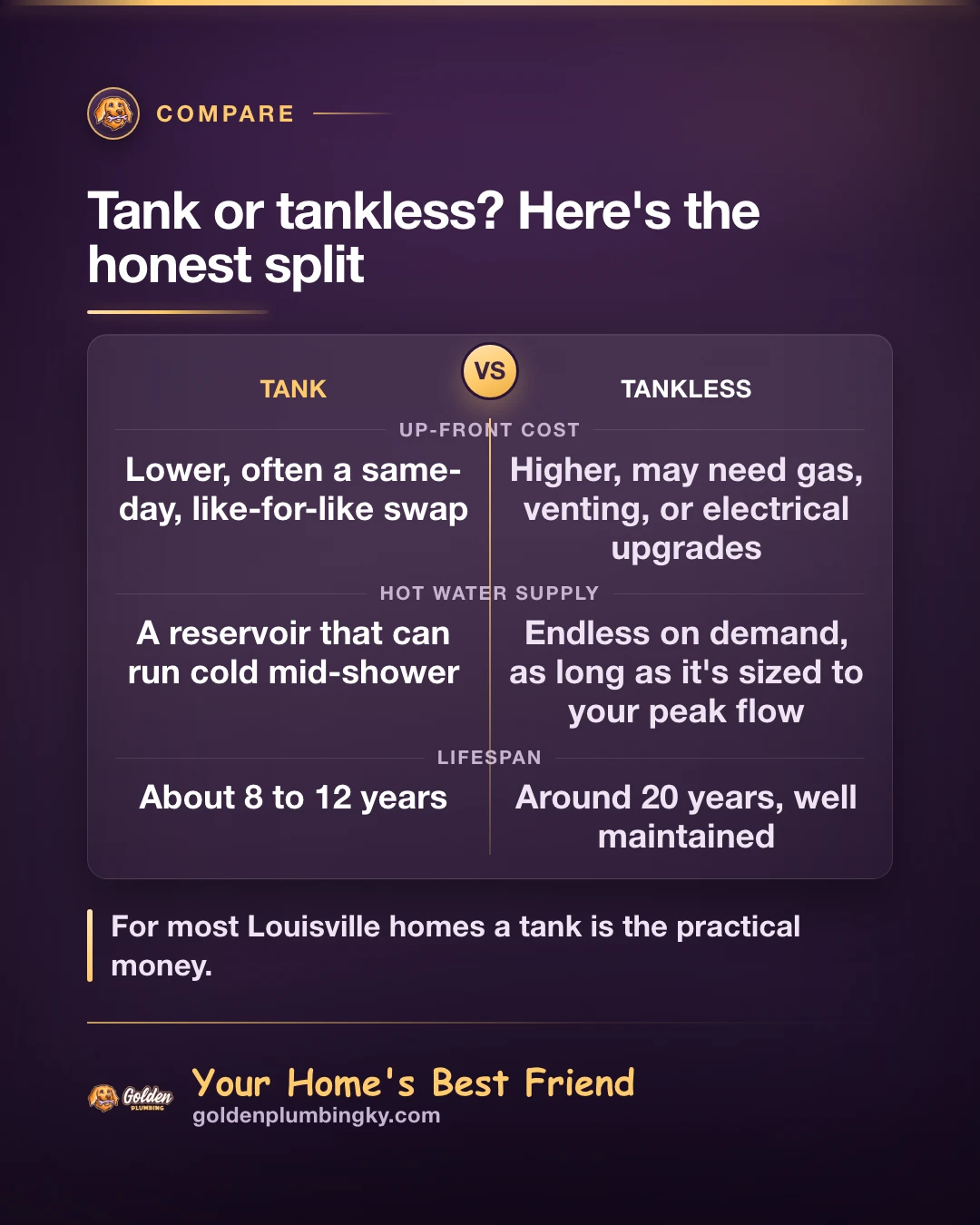
It comes down to your hot-water habits and your up-front budget. A tank is cheaper to buy and install, simpler to service, and completely fine for most families — a standard 50-gallon gas tank runs about $2,200–$2,400 installed, usually a same-day, like-for-like swap. A tankless unit costs more up front (commonly $5,200–$5,400 to $6,000–$6,200 installed, and it often needs gas, venting, or electrical upgrades) but never runs out of hot water and lasts longer. For most Louisville homes a tank is the practical choice — go tankless when you regularly run out of hot water, want the endless supply, or need to reclaim the floor space.
Tankless water heaters get talked about like they’re an automatic upgrade, and they’re genuinely good technology — but they aren’t the right call for everyone. A tank keeps a reservoir of hot water ready to go; a tankless unit heats water on demand as it flows through. That difference is real, and so is the price gap to install one. The honest way to decide is to ignore the hype and look at how your household actually uses hot water.
When a tank is the right call
For a lot of Louisville homes, a standard tank is simply the better value. It costs less to buy, and when you already have a tank, replacing it is usually a straightforward same-day job with no new gas lines, venting changes, or electrical upgrades. If your current hot water is “good enough” and you’re just replacing an aging unit, a tank puts more of your money toward the heater and less toward reworking your house.
- Lower cost up front A tank costs less to buy and, when you’re replacing an existing tank, less to install — a standard 50-gallon gas tank runs about $2,200–$2,400, less than half a typical tankless install. For a lot of households that’s the whole decision.
- A simple, same-day swap Tank-for-tank is a clean replacement — no upsized gas line, no new venting, no panel upgrade. In and out in a day, hot water back that afternoon.
- Your current hot water is already fine If you rarely run out, you’re paying a premium for a problem you don’t have. A tank keeps what works.
- Cheaper, simpler repairs down the road When something fails on a tank, it’s usually a common, inexpensive part. Tankless units are more complex to diagnose and service.
- Easier to live with on Louisville’s hard water Both types need care here, but a tank is more forgiving — an annual flush (about $100–$200) and a fresh anode rod, and it soldiers on. Tankless demands more disciplined descaling.
When tankless is the right call
Tankless earns its higher price when you actually run out of hot water or you want the space back. Because it heats on demand, it won’t run cold in the middle of the fourth shower — you get an endless supply as long as you don’t exceed its flow rate. It hangs on the wall instead of eating a corner of the basement, and it typically outlasts a tank by years. Just know the up-front cost is real, and in Louisville a water softener is close to mandatory to protect it.
- You keep running out of hot water If the last person in the shower gets the cold end of the tank, tankless fixes that directly. It makes hot water continuously instead of draining a reservoir.
- A big or busy household Back-to-back showers, laundry, and dishes at the same time are exactly what tankless is built for — as long as the unit is sized for your peak demand.
- You want the floor space back A tankless unit mounts on the wall and frees up the footprint a tank takes in a basement or closet.
- Longer lifespan Well-maintained tankless units commonly last around 20 years — roughly double a typical tank — which softens the higher up-front cost over time.
- Lower standby energy loss A tank reheats itself around the clock to stay hot; tankless only fires when you open a tap, so it wastes less energy sitting idle.
The honest part: Louisville hard water and the up-front premium
Before you commit to tankless, two things we’ll always tell you straight:
- Tankless needs a softener here Louisville’s hard water scales up a tankless heat exchanger fast. Without a water softener and annual descaling (a tankless flush runs about $500–$600), you can lose efficiency and shorten its life — which erases a big part of the reason you bought it. Budget for the softener as part of the decision, not an afterthought.
- The install cost is real Going tankless often means a bigger gas line, new venting, or an electrical upgrade. That’s why the installed price — commonly $5,200–$5,400 to $6,000–$6,200 — is well above a tank, and it’s why a straight tank swap is the better money for a lot of homes.
- When we’d steer you tankless anyway Big family that runs out constantly, a cramped mechanical room where the space matters, or you’re planning to stay in the house long enough to bank the lifespan and energy savings. If that’s you, it’s worth it. If it isn’t, a good tank is nothing to apologize for.
Common questions
Common questions we get
Is a tankless water heater worth the extra cost?
It depends on how you use hot water. If you regularly run out, want the endless supply, or need the space back, the premium is worth it — especially over a 20-ish-year lifespan. If your current hot water is fine and you’re just replacing an aging unit, a tank usually gives you more value for the money. Ask Goldie can help you weigh it for your specific home.
Does tankless really never run out of hot water?
It won’t run out the way a tank does, because it heats continuously. The catch is flow rate — a unit has a limit on how many gallons per minute it can heat at once. Size it right for your peak demand and you’ll never notice the limit; undersize it and running two showers plus the dishwasher can stretch it thin.
Do I need a water softener for a tankless heater in Louisville?
We strongly recommend it. Louisville’s water is hard, and the minerals scale up a tankless heat exchanger quickly. A softener plus a yearly descale protects the unit’s efficiency and lifespan. Skipping it is the fastest way to be disappointed in an expensive heater.
How long do tank and tankless heaters last?
A typical tank runs 8 to 12 years. A well-maintained tankless unit commonly lasts around 20. Maintenance matters a lot here — flushing a tank and descaling a tankless are what get you the top end of those ranges, and Louisville’s hard water is the main thing working against you.
The next questions to ask
Torn between a tank and going tankless?
Ask Goldie asks a few quick questions about your home and hot-water habits and gives you a straight recommendation. Try it at goldenplumbingky.com/instant-estimate/