
LEARNING CENTER WATER LINES
Why do my pipes bang or hammer when I shut the water off?
The short answer
That bang or hammer when a faucet, toilet, or appliance shuts off is called water hammer — fast-moving water slamming to a stop with nowhere to go. It’s usually caused by air chambers that have waterlogged, a missing or failed water-hammer arrestor, water pressure that’s too high, or loose pipes rattling against your framing. It’s fixable, and worth fixing, because that repeated shock stresses your joints and fittings over the years.
Here’s what’s actually happening when you hear that bang. Water moving through your pipes has real momentum. When a valve slams shut fast — a toilet finishing its fill, a washing machine or dishwasher closing its valve — the water stops instantly but the momentum doesn’t, so it hits like a tiny hammer and sends a shockwave banging through the pipes. That’s why it’s called water hammer, and it’s not just noise: it’s a jolt your plumbing takes over and over.
What water hammer actually is — and why it started
Most homes are built with a way to cushion that shock. When the cushion stops working, or the pressure behind the water is too high, the bang shows up. Here’s what’s usually behind it.
- Waterlogged air chambers Older Louisville homes were plumbed with air chambers — short capped stubs of pipe near fixtures that trap a pocket of air to cushion the shock. Over years that air pocket gets absorbed into the water and the chamber fills up, so there’s nothing left to soften the blow. Draining the system to recharge them is often a free fix.
- A missing or failed water-hammer arrestor Modern plumbing uses mechanical arrestors — small sealed shock absorbers, usually right at the washer and dishwasher where valves snap shut hardest. If your home never had them, or an old one has failed, the shock has nowhere to go and you hear it. Adding an arrestor at an appliance runs about $200–$300.
- Water pressure that’s too high High pressure amplifies every shutoff. Anything over about 80 psi is beyond what code recommends, and it makes water hammer louder and harder on the system. Many Louisville homes have a pressure-reducing valve to keep street pressure in check — when it drifts or fails, banging often shows up alongside it, and replacing a 3/4-inch PRV runs about $600–$700.
- Fast-closing appliance valves Washing machines, dishwashers, and ice makers use electric valves that snap shut in a fraction of a second. That sudden stop is the most common trigger for the bang, which is exactly why arrestors belong at those connections.
When it’s not water hammer — just loose pipes
Not every noisy pipe is water hammer. Water hammer is a sharp bang the instant water shuts off. If your noise is more of a knock, tick, or rattle at other times, it’s usually pipes moving — a different, gentler problem.
- Pipes not strapped down If a pipe isn’t secured well where it runs through studs or joists, the surge of water starting or stopping makes it knock against the framing. Securing or cushioning the pipe usually quiets it.
- Ticking as pipes heat and cool Hot water lines expand when hot water runs and contract as they cool, and they can tick or creak sliding against framing. That’s thermal movement, not water hammer — harmless, though the same cushioning that fixes rattles often quiets it too.
Try the free fix first — then when to call
There’s a no-cost thing to try before anyone comes out, plus a couple of signs it’s worth a call:
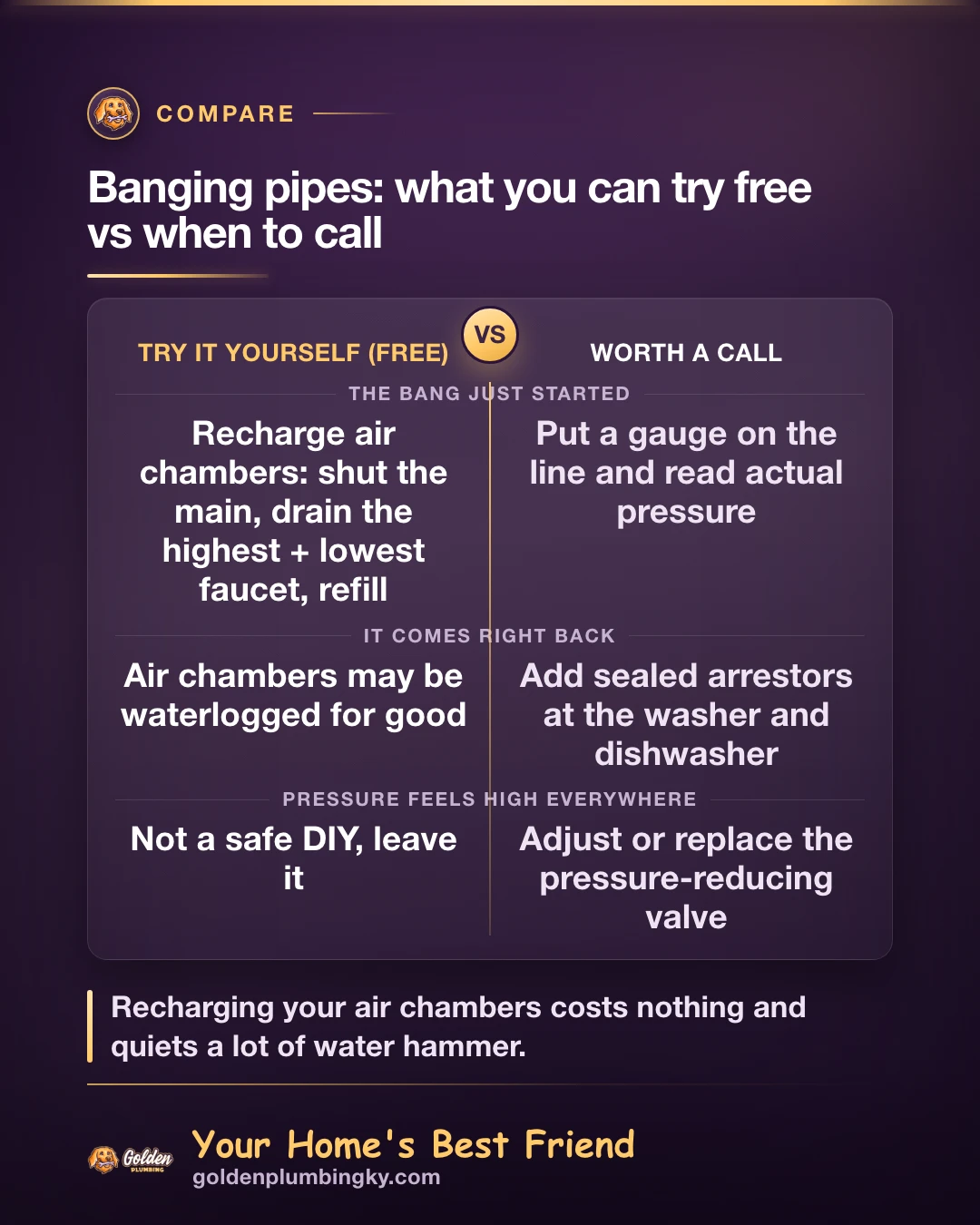
- Recharge the air chambers yourself, for free Shut off your main water valve, open the highest faucet in the house and the lowest one (often a basement or outside spigot), let it all drain, then close them and turn the water back on. That refills the air chambers with air and often stops the banging with no parts and no cost.
- The banging is new and your water pressure feels high High pressure hammers the whole system and can shorten the life of fixtures, connections, and appliances. If pressure seems strong everywhere, it’s worth having it measured — it may be a pressure-reducing valve that needs adjusting or replacing.
- You see corrosion or weeping at the joints Repeated shock can slowly work a fitting loose. If you spot dampness or corrosion at a joint near where the banging happens, get it looked at before a small weep becomes a leak.
How we’d approach it
When we chase down water hammer, the first thing we do is put a gauge on your incoming water and read the actual pressure — because high pressure is the hidden multiplier behind most bad cases, and no amount of arrestors fully fixes it if the pressure’s wrong. From there we check whether you have a pressure-reducing valve and an expansion tank (about $400–$500 to add), then add water-hammer arrestors at the appliances that slam shut. More often than not the whole thing is solved with a pressure adjustment and a couple of arrestors — a modest job, not a repipe. If the noise turns out to be loose pipes instead, we’ll secure them and save you the parts.
Common questions we get
Is water hammer actually dangerous?
Not in a dramatic, burst-today way, but it’s not harmless either. The repeated shock stresses joints, fittings, and appliance valves over time, and it can eventually work a connection loose into a leak. That’s the real reason to fix it — you’re preventing wear, not just quieting a noise.
How do I fix water hammer myself?
The free first step is recharging your air chambers: shut off the main, open the highest and lowest faucets to drain the system fully, then close them and turn the water back on. That refills the cushions with air. If the banging comes right back, the air chambers may be gone for good and you’re looking at mechanical arrestors or a pressure check instead.
Why do my pipes only bang when the washer or toilet fills or stops?
Because those have fast-closing valves. A washing machine or toilet fill valve snaps shut quickly, and that sudden stop is exactly what creates the shockwave. It’s why arrestors are installed right at those appliances — they catch the shock at the source instead of letting it travel through the house.
Can high water pressure cause banging pipes?
Yes, and it’s one of the most overlooked causes. Pressure above about 80 psi is beyond the recommended range and makes every shutoff hit harder. If your pressure is high, fixing it with a pressure-reducing valve often quiets the banging and protects your whole system at the same time — which is why we always measure pressure first.
The next questions to ask
Not sure if it’s air chambers, high pressure, or just loose pipes?
Ask Goldie walks you through it in a couple of minutes and tells you what’s likely going on before anyone comes out. Try it at goldenplumbingky.com/instant-estimate/