
LEARNING CENTER WATER HEATERS
Why is my water heater rumbling or popping? (and what to do about it)
The short answer
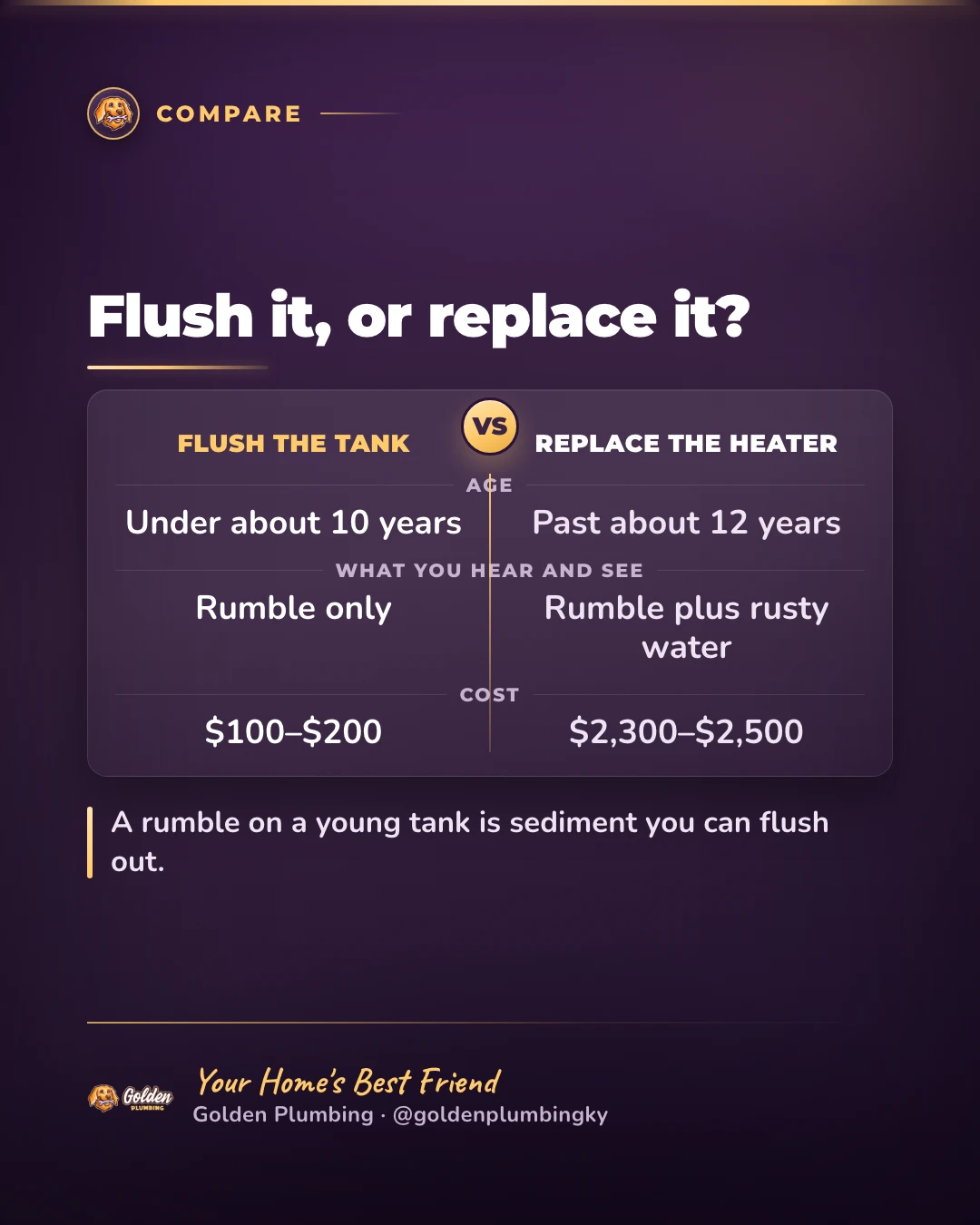
That rumbling, popping, or crackling is almost always sediment. Hard-water minerals settle into a crusty layer on the bottom of the tank, water gets trapped underneath it, and when the burner or element fires that trapped water boils and forces its way out through the crust. The sound is steam escaping, not a tank about to blow. It’s still worth paying attention to: sediment steals hot-water capacity, costs you money to heat around, and shortens the life of the heater. Flushing the tank runs $100–$200 and often quiets it down. On a tank well past ten years, a hard rumble usually means the end is coming rather than a problem to fix.
A water heater that suddenly sounds like a coffee pot, a popcorn maker, or somebody kicking a bucket in the basement gets people worried fast. We take these calls a lot in Louisville, and the honest answer is that the noise is rarely an emergency. It’s a symptom, and a pretty readable one. Here’s what’s going on inside that tank and what’s actually worth doing about it.
What the rumble actually is
Louisville water is hard, which means it’s carrying dissolved calcium and other minerals. Every time your heater warms a tank of it, a little of that mineral drops out of solution and settles to the bottom. Over the years it builds into a crusty layer sitting right where the heat comes in.
On a gas heater, the burner is underneath that layer. Water works its way into pockets under the crust, gets superheated, and flashes to steam. The steam bubbles have to push up through the sediment to escape, and that’s the rumble, the pop, the percolating sound. On an electric heater, sediment bakes onto the lower element instead, so you get more of a sizzle, crackle, or hiss as the element cooks the crust stuck to it.
Either way, the tank isn’t about to rupture. The noise is steam, and your heater has a temperature and pressure relief valve specifically to handle pressure. What the noise really tells you is that heat is fighting through a layer of rock to reach your water.
Which sound is yours
- Rumbling, popping, or percolating The classic sediment signature, and by far the most common thing we hear on gas tanks. It usually gets louder during a heating cycle, right after somebody uses a lot of hot water. If the sound crept in over years rather than showing up overnight, you’re almost certainly listening to sediment.
- Sizzling, crackling, or hissing Typical on electric tanks, where the lower element is buried in sediment and boiling the water trapped against it. Worth checking soon, because an element that’s caked in mineral runs hot, wears out early, and can leave you with a short shower before it quits entirely.
- A single knock or bang when a faucet shuts off That’s probably not the heater at all. A sharp bang in the pipes right when water shuts off is water hammer, and that’s a pressure issue in the plumbing, not sediment in the tank. Different problem, different fix.
- Ticking or light clicking Usually just metal expanding and contracting as pipes heat and cool, or a heat trap nipple doing its job. Annoying, harmless, and not something we’d charge you to chase.
- A loud screech or whistle That’s water forcing through a restriction, often a partly closed valve. Not sediment, and worth a look, because something’s choking your flow.
What it’s costing you
Here’s the part people don’t usually connect. That sediment layer takes up room that used to hold hot water, so you get less of it before it runs cold. It also insulates the burner from the water above it, which means the heater runs longer and burns more gas or draws more power to hit the same temperature. And the steel at the bottom of the tank sits hotter than it was designed to, which is hard on the liner over time.
So the noise isn’t the problem. The noise is the receipt. Shorter showers, a higher utility bill, and a tank aging faster than it should: those are the actual costs.
What to do about it
- Flush the tank This is the first move on a heater that isn’t too far gone. We drain the tank, break loose what we can, and get the sediment out. A tank flush runs $100–$200. On a heater that’s been flushed regularly, or one where the buildup is still soft, this often quiets the rumble right down and restores some capacity. Being straight with you: on a tank that’s never been flushed in twelve years, that layer can be hardened into place, and a flush may only help a little.
- Check the anode rod while we’re in there The anode rod is a sacrificial metal rod that corrodes so your tank doesn’t. Once it’s spent, the tank starts rusting from the inside. Replacing it runs $400–$500, and on a tank that’s otherwise healthy it can buy years of extra life. On a tank already near the end, it’s money better saved toward the replacement.
- Get it diagnosed if you’re not sure what you’re hearing If the sound doesn’t match anything above, or it came on suddenly, a real diagnosis beats guessing. A water heater diagnosis, gas or electric, runs $100–$200. That’s a paid visit, not a freebie, and it tells you exactly what you’re dealing with instead of buying parts on a hunch.
- Turn the temperature down a notch Free, and it helps. Hotter water drops minerals out of solution faster. If your heater’s set high, dialing it back toward 120 degrees slows the buildup and it’s easier on everybody in the house. Don’t go so low that you invite bacteria growth in a tank that sits unused for long stretches.
When the rumble means something bigger
Most of the time this is a flush. A few situations change the answer, and we’d rather tell you than take your money for a flush that won’t help:
- The tank is past about twelve years and rumbling hard At that point the noise is usually the tank telling you it’s near the end rather than a fixable condition. A standard 50-gallon natural gas replacement runs $2,200–$2,400, so it’s worth planning for on your terms instead of on a Saturday night. We’ll still tell you honestly if a flush is worth trying first.
- You see water pooling underneath A leak from the body of the tank isn’t a repair. Once the steel liner corrodes through, there’s no part to swap. That’s a replacement conversation, and standing water near a gas burner or electrical connections needs eyes on it soon.
- The hot water has turned rusty or brown Discolored hot water alongside a rumble usually means corrosion inside the tank, not just mineral buildup. A flush and an anode rod may help if it’s caught early. If the tank is well rusted, it’s on its way out.
- The relief valve is dripping or discharging If the T&P valve on the side of the tank is releasing water, stop and call someone. That valve is a safety device doing its job, and it’s worth finding out why it’s doing it.
If yours is tankless
Tankless units don’t rumble, because there’s no tank of standing water and no sediment bed. What they do get is scale building up inside the heat exchanger, and that shows up as reduced flow, temperature swings, or an error code rather than a noise. The fix there is a descaling flush, which runs $500–$600. If you’ve got a tankless unit making a genuine rumbling or banging sound, that’s worth a look, because it isn’t the normal wear pattern for that equipment.
Common questions we get
Is a rumbling water heater dangerous?
In almost every case, no. The sound is steam escaping from under a sediment layer, and your tank has a temperature and pressure relief valve designed to handle pressure. What it does mean is that the heater’s working harder than it should and aging faster than it should. The exceptions worth acting on quickly are a relief valve that’s discharging, water pooling under the tank, or a gas smell.
Will flushing my water heater stop the noise?
Often, yes, especially if the buildup is still loose. A flush pulls the sediment out, which lets the burner heat the water directly again and usually quiets things down. On a tank that’s never been flushed and has years of hardened mineral in the bottom, a flush may only take the edge off. We’ll tell you which situation you’re in rather than sell you a flush that won’t deliver.
How often should a water heater be flushed in Louisville?
With water as hard as ours, about once a year is a reasonable rhythm, and it’s one of the few maintenance items that genuinely pays for itself in tank life and efficiency. If yours has never been flushed and it’s already rumbling, start with one and see how it responds before committing to a schedule.
My heater is twelve years old and rumbling. Flush it or replace it?
Age is the deciding factor. Most tank heaters last about 8 to 12 years, and Louisville’s hard water pushes toward the low end of that. At twelve years with a hard rumble, we’d be honest that a flush is a coin flip and that you’re better off deciding on a replacement while the tank is still dry rather than after it lets go. If the tank is younger and holding water fine, flush it.
Can I flush the tank myself?
Plenty of homeowners do, and if you’re comfortable shutting off the gas or power, running a hose from the drain valve, and refilling without leaving air in the tank, it’s a reasonable DIY. Two cautions: on an old tank the plastic drain valve can break or fail to reseal when you open it, and a tank that’s never been flushed can clog that valve with sediment. If either of those happens, you’ve gone from a noisy heater to no water heater, so know that going in.
The next questions to ask
Not sure if that rumble is a cheap flush or a tank near the end?
Ask Goldie walks you through it in a couple of minutes and tells you what’s likely going on before anyone comes out. Try it at goldenplumbingky.com/instant-estimate/