
LEARNING CENTER GENERAL
When You Don’t Need a Plumber: Fixes to Try First
The short answer
A lot of the calls we get are things you can fix in about five minutes for free. A running toilet, a jammed disposal, a tripped breaker, or low pressure at one faucet. Run the quick checks below before you book anyone. But if you smell gas, see sewage backing up, or can’t shut the water off, skip all of it and call now.
Here’s something most plumbing companies won’t put on their website: you don’t always need us. Some of the most common calls we get turn out to be a quick fix the homeowner could’ve handled without paying anybody. We’d rather tell you that up front. So before you book a plumber, ours included, run through these six checks. Most of them cost nothing and take a few minutes.
The toilet that won’t stop running
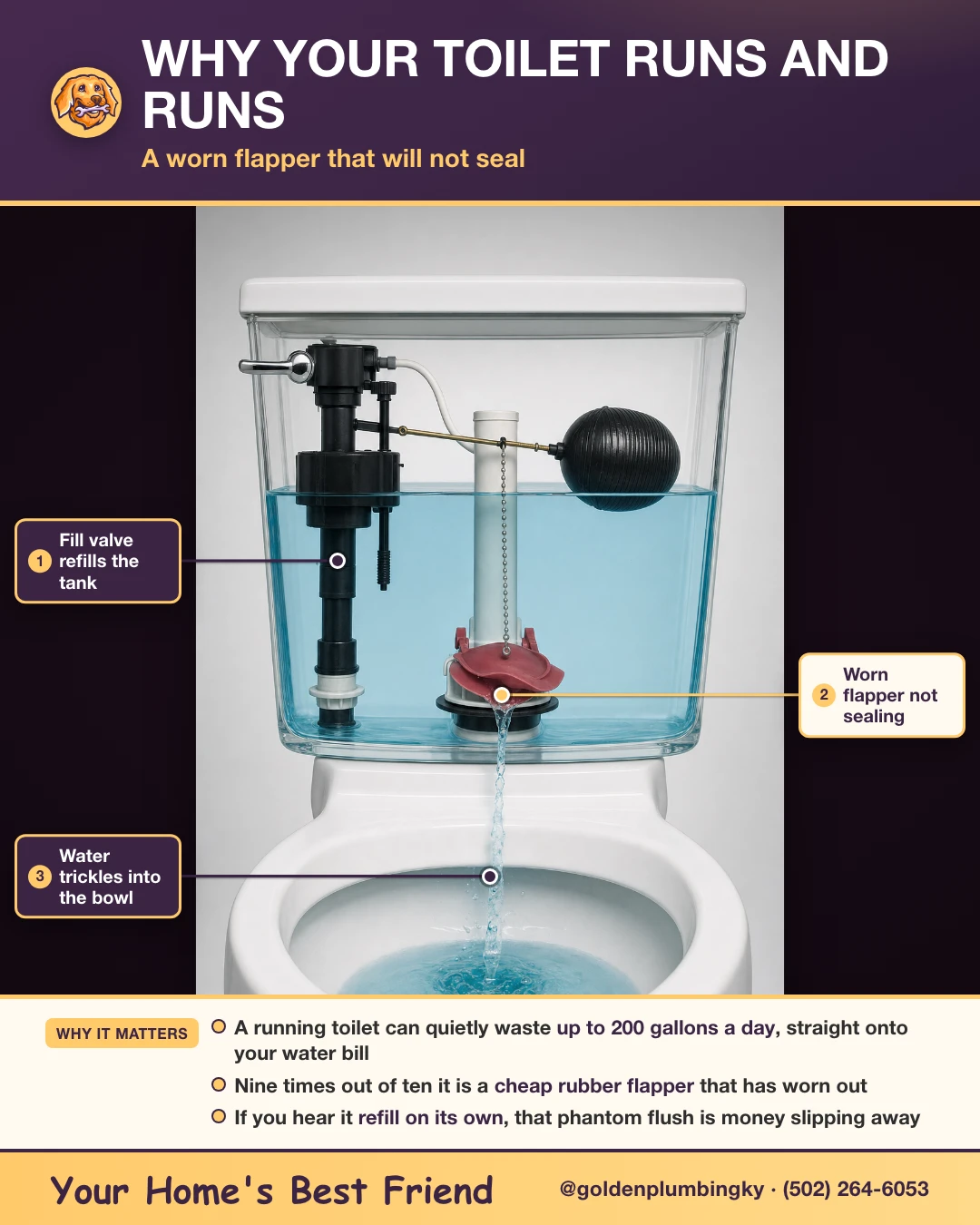
Lift the tank lid and look at the flapper, the rubber seal at the bottom that lifts when you flush. If it’s warped, crusty, or won’t sit flat, it isn’t sealing, and that’s what keeps the water cycling. A new flapper is a few dollars at any hardware store and takes about ten minutes, no tools needed. Shut off the little valve behind the toilet, flush to empty the tank, unclip the old flapper, and clip the new one on.
So when is it worth calling? If you’ve swapped the flapper and it still runs, or the fill valve keeps hissing and won’t shut off, that’s a fair time to book someone. We charge $100–$200 to replace a flapper, and almost nobody has us do it. Most people handle this one themselves, and they should.
A garbage disposal that just hums or does nothing
Two buttons save most disposal calls. First, look under the sink at the bottom of the unit for a small red reset button. Press it. If the disposal was dead-silent, a tripped reset is usually why. Second, if it hums but won’t spin, something’s jammed. Kill the power at the wall switch, then find the little hex wrench (the allen key that came with the disposal, often clipped to the underside). Fit it into the socket on the very bottom of the unit and turn it back and forth to free the jam. Never put your hand down the drain.
Call us when the reset won’t stay in, the hex crank won’t budge, or it’s leaking from the body. Unjamming a disposal runs $100–$200, and a new half-horsepower unit installed is $600–$700. The garbage disposal is one of the most common small calls we get, and a good share of them get solved by the exact red button and hex wrench we just walked through. Try those before you pay anybody.
No hot water, and the breaker keeps tripping
If you’ve got an electric water heater and no hot water, check the breaker panel first. If the water-heater breaker has flipped, reset it once. Sometimes it’s a one-time nuisance trip and you’re back in business.
Here’s the part that matters. If it trips again right away, stop. Don’t keep flipping it back on. A breaker that won’t hold is telling you something’s wrong, usually a failed heating element or a shorted thermostat, and forcing it over and over is how you cook wiring or start a bigger problem. That’s a diagnostic call, our standard $89, and we put it toward the repair if you move forward. Got a gas water heater that won’t stay lit? Same rule. Don’t keep relighting it.
Low water pressure at one faucet
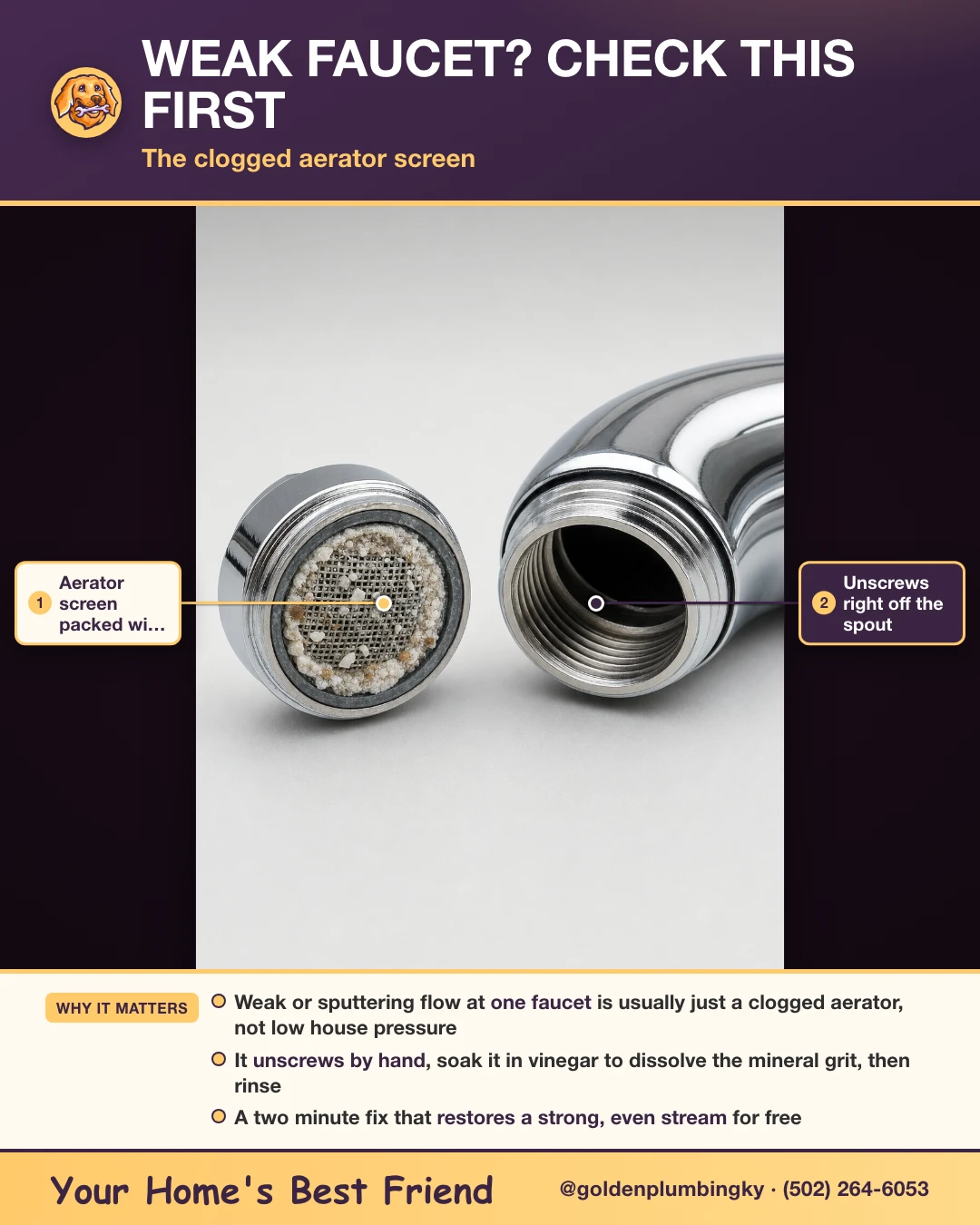
If the weak pressure is at just one faucet and the rest of the house is fine, it’s almost never a big deal. Unscrew the aerator, the little screen tip on the end of the spout, and you’ll probably find it packed with white mineral crud. Louisville water runs on the hard side, so that buildup is common around here. Soak the screen in vinegar for a bit, rinse it, screw it back on. Usually the pressure comes right back.
When it’s worth a call: if low pressure hits the whole house at once, or it dropped suddenly across every fixture, that’s a different animal. Could be the pressure regulator, a partly closed valve, or a supply issue, and that one’s worth having somebody look at.
A clogged drain, before you buy a snake
Reach for the plunger first, and use it right. For a sink, block the overflow hole (or the second basin) with a wet rag so you build real suction instead of leaking air. Run enough water to cover the plunger cup, then give it firm, straight pumps. For a toilet, a good flange-style plunger clears most soft clogs if you commit to it.
When to stop: if plunging does nothing, if more than one drain is slow at the same time, or if running one fixture backs water up into another (you flush the toilet and the tub gurgles), that’s a main-line problem and a plunger won’t touch it. Clearing a toilet blockage is $100–$200, and a main line cleared with our machine runs $300–$400. One more thing: please don’t pour in a bottle of chemical drain cleaner and then a second one when it doesn’t work. It rarely clears a real clog, and it makes the drain more hazardous for whoever opens it next.
Know where your main shutoff is, before you need it
This isn’t a repair. It’s the one thing that turns a burst-pipe disaster into a mess you can mop up. Find your main water shutoff now, while nothing’s wrong. In most Louisville homes it’s near where the water line enters the house, often in the basement, a crawlspace, or close to the water heater. Turn the handle so you know which way is off, then make sure everyone in the house knows where it is too.
If you don’t have a working main shutoff, or the valve is seized and won’t turn, get that fixed on a calm afternoon, not in the middle of an emergency. A new main shutoff valve runs $500–$600. That’s cheap insurance against a line letting go at 2 a.m.

Skip the DIY and call right now if:
A few situations aren’t DIY-friendly at all. If any of these is happening, stop reading and get help.
- You smell gas Leave the house first, then call from outside, and call the gas company too. Don’t flip switches, don’t go hunting for the source. Gas is the one thing where you don’t investigate, you leave.
- Sewage is backing up Raw sewage coming up a drain, toilet, or tub is a health hazard and usually points to a main-line failure. Stop running water in the house and call.
- You can’t shut the water off If a line’s leaking and there’s no working shutoff, that’s a real emergency. Get it stopped fast.
- Water is near electrical Standing water around outlets, the breaker panel, or the water heater’s wiring is dangerous. Kill power at the breaker only if you can reach it safely and dry, then call.
Some of this isn’t for everyone
These are homeowner-friendly checks, not a dare. It’s completely fine to skip them if:
- You’re not comfortable If reaching under a disposal or opening a breaker panel makes you uneasy, that’s a perfectly good reason to call. No judgment here.
- It’s a rental Call your landlord or property manager first. It’s their repair and their bill, not yours.
- You already tried the fix If you ran the check and it didn’t hold, you’re past DIY. That’s a real service call now, and that’s okay.
Common questions we get
Will you really tell me if I don’t need a plumber?
Yes. Our techs are here to solve the problem, not to run up a ticket. If you call and it turns out to be something you can handle in five minutes, we’ll say so, often right on the phone.
How much is a service call if I do end up needing you?
Our standard diagnostic is $89, and we credit it toward the job when you approve the repair. After-hours and emergency visits are $199.
Is it safe to reset the water heater breaker myself?
Resetting it once is fine. If it trips again immediately, stop and call. A breaker that won’t hold means there’s a real electrical fault, and forcing it repeatedly can damage wiring.
The hardware store flapper didn’t fix my running toilet. Now what?
Then it’s probably the fill valve or the tank-to-bowl seal, not the flapper itself. Those are still doable for a handy homeowner, but if you’d rather not chase it, that’s a fair service call and we’ll take care of it.
Not sure what your home needs?
Ask Goldie walks you through it and gives you a real price in a couple of minutes. No phone call required.