
LEARNING CENTER WATER HEATERS
Water heater flushes and anode rods: what maintenance is real (and what’s an upsell)
The short answer
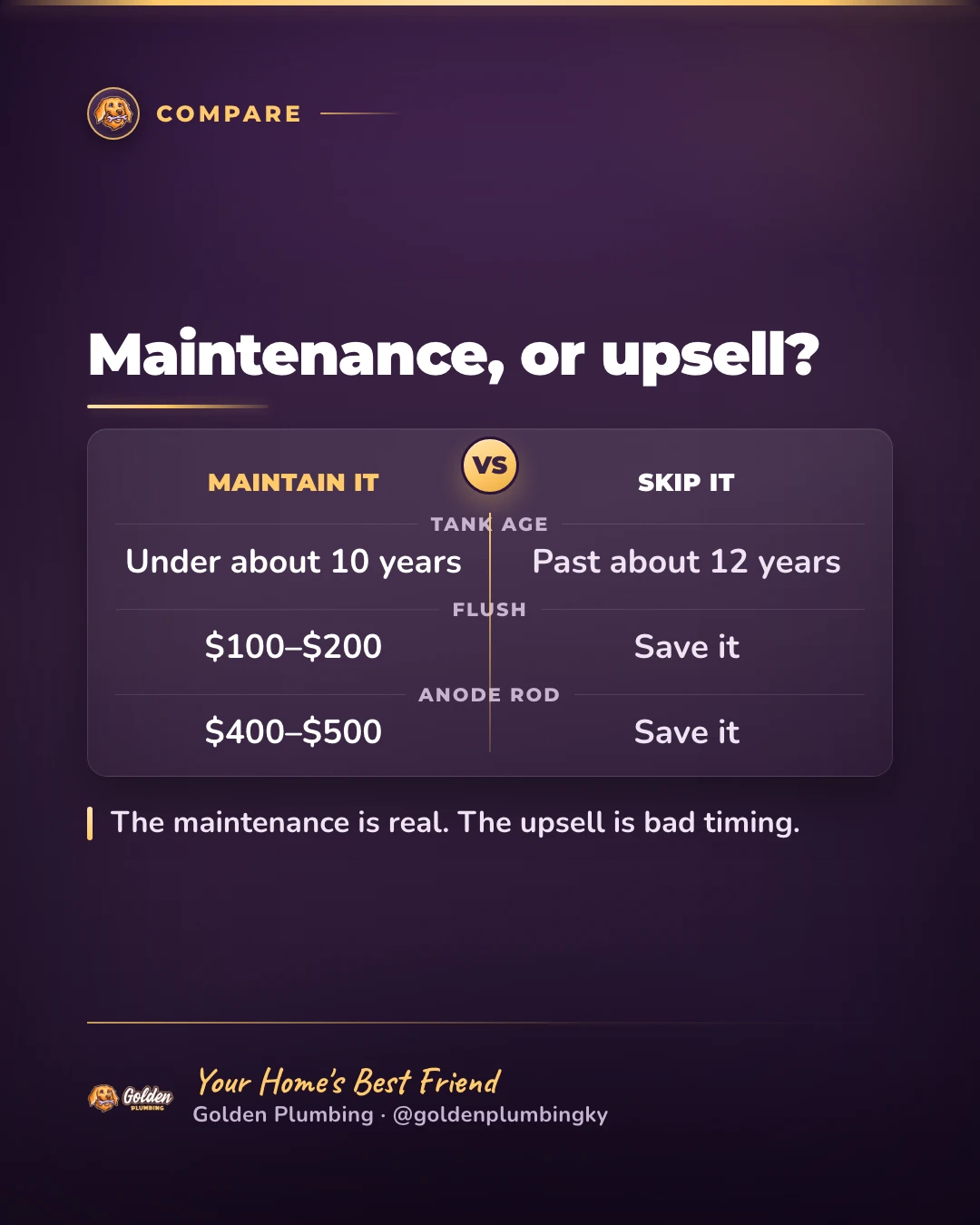
Straight answer: the two maintenance jobs a tank water heater actually needs are real. A tank flush runs $100–$200 and clears out the sediment Louisville’s hard water drops on the bottom of the tank, and an anode rod replacement runs $400–$500 and renews the sacrificial part that corrodes so your tank doesn’t. Done at the right time, both genuinely extend the life of the heater. The upsell isn’t the maintenance itself, it’s the timing. Sold on a tank past ten or twelve years old, either job is money better saved toward the replacement, and any pitch claiming a flush will fix rusty water or a dying heater is selling hope, not maintenance.
Nobody calls a plumber asking for water heater maintenance. The call we actually get is the suspicious one: a tech from some company quoted a flush and an anode rod on the way out the door, and the homeowner wants to know whether that was real or just ticket padding. Fair question. We sell these exact services, so consider this us grading our own homework. Both jobs are legitimate. Both also get sold at moments when they’re a waste of your money, and telling those moments apart takes about ten minutes of reading.
The two jobs that are actually real
Louisville city water runs moderately hard, around 7 grains per gallon. Every time your heater warms a tankful, a little of that dissolved mineral drops out of solution. Some of it settles to the bottom of the tank as sediment. Meanwhile, the hot mineral-rich water spends every day of its life trying to corrode the steel tank it sits in. Those two slow-motion problems are the entire reason tank maintenance exists, and each one has exactly one honest answer.
- The tank flush, about once a year We hook a hose to the drain valve, drain the tank, break loose what we can, and get the sediment out before it hardens into a crust. A flush runs $100–$200. What you get back is real: more usable hot water, a burner that isn’t heating through a layer of rock, a quieter tank, and a slower aging curve. One honest caveat: on a tank that’s gone ten or twelve years without a single flush, the buildup can be baked into place, and a flush may only take the edge off. We’ll tell you that before we start, not after.
- The anode rod, when it’s spent The anode rod is a long metal rod that hangs down inside the tank and exists to be destroyed. It’s made of a metal that corrodes more easily than steel, so the corrosion in the water attacks the rod instead of the tank liner. Once the rod is eaten down to its core wire, the tank itself is next on the menu. Replacing it runs $400–$500, and on a healthy mid-life tank it’s the best dollar-for-dollar life extender in plumbing. On a tank already near the end, it’s money better saved toward the replacement, and we’ll say so.
- The tankless descaling flush Tankless units skip the sediment bed but grow scale inside the heat exchanger instead, which shows up as temperature swings, reduced flow, or an error code. The answer there is a descaling flush, which runs $500–$600. This one is less optional than people assume: manufacturers expect regular descaling in hard-water areas like ours, and some tie warranty coverage to it.
Where the honest work turns into an upsell
Here’s the thing about water heater maintenance: the services themselves are almost never fake. The dishonesty, when it shows up, is nearly always about timing or about promises. Watch for these.
- Maintenance pitched on a tank that’s already old Most tank heaters last about 8 to 12 years, and Louisville’s hard water pushes toward the short end of that. Putting several hundred dollars of flushes and anode rods into a twelve-year-old tank isn’t maintenance, it’s a donation. At that age the money belongs in the replacement fund. A standard 50-gallon natural gas swap runs $2,200–$2,400, and doing it on your schedule beats doing it the night the tank lets go.
- A flush sold as a repair A flush is prevention. It won’t bring back hot water that a failed part took away, it won’t cure rusty water coming from a corroded tank, and it won’t fix a leak. If you have a symptom and the only prescription offered is a flush, get a real diagnosis instead. A water heater diagnosis, gas or electric, runs $100–$200 and tells you what’s actually wrong before you spend anything on a cure.
- Fear doing the selling If the pitch involves your tank exploding, walk away. Sediment costs you efficiency, capacity, and tank life. It is not a bomb. Your heater carries a temperature and pressure relief valve whose entire job is handling pressure. A company leaning on fear instead of math doesn’t deserve the work, ours included.
- Miracle bottles and gadgets Chemical de-limers and clip-on devices that promise to dissolve years of hardened buildup are mild helpers at best and pure margin at worst. No additive outperforms a hose and gravity. And while a real water softener genuinely does slow scale at the source, that’s a whole-house decision with its own price tag, not a rescue device you buy because one appliance is getting old.
Four questions that keep any plumber honest
You don’t need to know plumbing to protect yourself. Ask these before saying yes to any maintenance quote, ours included:
- How old is this tank? If the honest answer is past ten years, the follow-up question is why we’re maintaining it instead of planning its replacement. A good tech will have an answer that isn’t a shrug.
- Can I see the rod? A spent anode is obvious even if you’ve never seen one: it looks like a chewed wire instead of a solid rod. Any tech who actually pulled it will happily show you. If it never leaves the tank, you didn’t buy an inspection.
- What came out in the flush? Ask to see the first bucket. Cloudy water with grit in it means the flush was doing something. Clean water start to finish on a supposedly urgent flush tells its own story.
- Would you do this on your own heater? Simple, and surprisingly effective. People who fix things for a living have strong opinions about what they’d spend on their own equipment. Make them commit to one.
The honest schedule, by age of the tank
- Years 0 to 5 Flush about once a year. In water this hard, that single habit protects capacity and keeps the sediment from ever hardening. Have the anode checked somewhere around year three to five; in Louisville water, a first rod is often well eaten by then.
- Years 6 to 9 Keep flushing if the tank’s been maintained. This is also the sweet spot for the anode swap: the tank still has years of steel left worth protecting, so a new rod actually buys you something. This is the stretch where maintenance pays best.
- Year 10 and beyond Stop investing. If it’s still making hot water, let it ride, keep an eye on the floor around it, and start the replacement conversation on your terms. Maintenance sold here is the actual upsell this article is about.
Can you just do it yourself?
The flush? Honestly, yes. If you’re comfortable shutting off the gas or power, connecting a garden hose to the drain valve, and refilling the tank without leaving air in it, it’s a fair DIY job and your heater’s manual walks through it. Two cautions from experience: on an older tank the plastic drain valve can snap or refuse to reseal once opened, and a tank that’s never been flushed can clog that valve with sediment mid-drain. Either way you’ve upgraded a maintenance chore into a no-hot-water day, so know your exit before you start.
The anode rod is a different animal. The hex head is usually factory-torqued into the top of the tank hard enough to need a breaker bar or an impact wrench, and a full-length rod needs several feet of clearance above the heater to come out, which most Louisville basements and utility closets don’t have. There are segmented rods for tight spaces, but between the torque, the headroom, and the judgment call about whether the rod even needs replacing, this is the one we’d suggest paying for.
Common questions we get
Is a water heater flush actually necessary in Louisville?
In our water, yes. It’s one of the few maintenance items that genuinely pays for itself. Around 7 grains per gallon of hardness means every heating cycle leaves a little mineral behind, and an annual flush keeps that from becoming a crust that steals capacity and burns extra gas. The honest exception is a tank that’s already old or has never been flushed. At that point the flush may not accomplish much, and we’ll say so before charging you for it.
How do I know if my anode rod needs replacing?
You have it checked, which can happen during a flush visit. A rod that’s still mostly solid metal goes back in. A rod that’s eaten down to its steel core wire is done, and the tank is unprotected until it’s swapped. One extra clue: if your hot water has picked up a rotten-egg smell, the anode is often involved, because certain water chemistry reacts with the rod. That’s a fixable problem, not a reason to replace the heater.
My tank is 12 years old and someone quoted a flush and an anode rod. Should I do it?
We’d say no, and we’d say it even though we sell both services. At twelve years the tank has already outlived the average, and several hundred dollars of maintenance won’t rewind the corrosion clock. Put the money toward the replacement instead. A standard 50-gallon gas swap runs $2,200–$2,400, and choosing the install date yourself beats letting the tank choose it for you.
Will a flush make my water heater quieter?
Often, yes. The rumbling and popping people hear is steam escaping from under the sediment layer, so pulling the sediment out usually calms it down, especially while the buildup is still loose. If the tank is old and the crust has hardened, a flush may only take the edge off. Either way the noise itself isn’t dangerous. It’s just the tank showing you its receipts.
Does skipping maintenance void my warranty?
It can complicate it. Tank warranties generally assume the heater was installed and maintained per the manual, and the manual calls for flushing and anode checks. Where this gets real is tankless: some manufacturers tie warranty coverage on the heat exchanger to regular descaling and to water quality. If you own a tankless unit in Louisville water, keep the descaling receipts. That paper trail is worth actual money.
The next questions to ask
Not sure if the maintenance you were quoted is real or padding?
Ask Goldie walks through your heater’s age and symptoms in a couple of minutes and tells you what’s actually worth doing. Try it at goldenplumbingky.com/instant-estimate/