
LEARNING CENTER WATER QUALITY
Do I really need a water softener in Louisville?
The short answer
Honest answer: most Louisville homes on city water don’t strictly need a softener — our tap water is moderately hard, not the extreme hardness you’d fight on a private well. A softener is worth it if you’re seeing real scale on fixtures, you’re on well water, you run a tankless heater the maker wants softened water for, or the effects (spotty dishes, dry skin, dingy laundry) genuinely bug you. If your actual complaint is taste or smell, you don’t want a softener at all — you want a filter, which is a different piece of equipment.
This is one of those questions where the easy sale would be “yes, everybody needs one.” We’re not going to tell you that, because it isn’t true. Plenty of Louisville homeowners live perfectly happily without a softener and would be spending money to fix a problem they don’t really have. So let’s sort out who actually benefits, who doesn’t, and — just as important — the folks who think they want a softener but really need something else.
First, how hard is Louisville’s water really?
Louisville Water is genuinely good water — the utility has a strong reputation, and if you’re on city supply, what comes out of your tap is moderately hard. “Hard” means dissolved minerals, mostly calcium and magnesium. Enough of it here to leave some scale over time and spot up your glassware, but nowhere near the punishing hardness people deal with on private wells or in parts of the desert Southwest. That middle-of-the-road reality is exactly why the answer isn’t a simple yes or no — it comes down to how much the effects bother you.
Who actually benefits from a softener
There are real situations where a softener earns its keep. If you see yourself in a couple of these, it’s a fair investment.
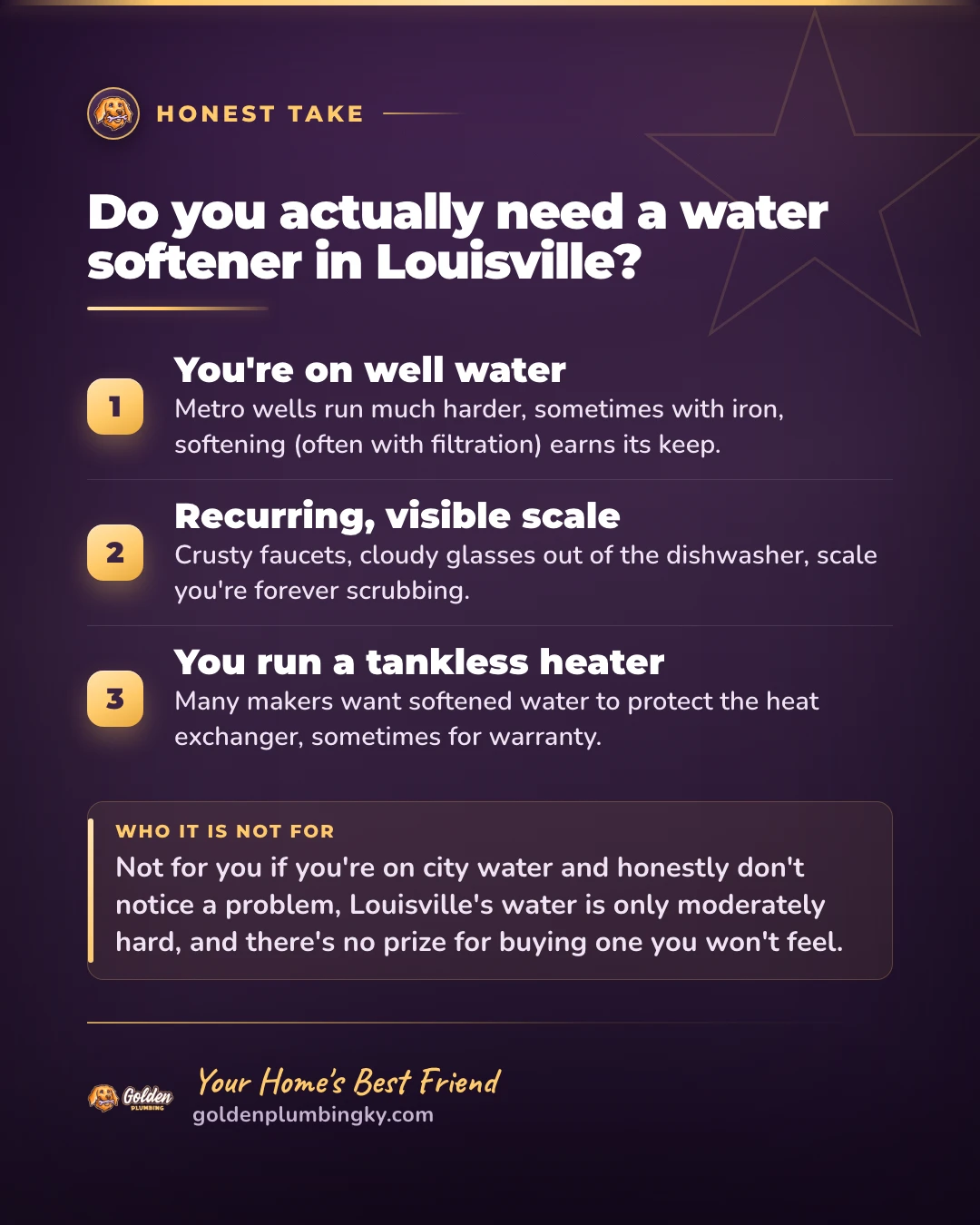
- You’re on well water Private wells around the Louisville metro often run considerably harder than city water, sometimes with iron and other minerals on top. If you’re on a well and seeing orange staining or heavy scale, softening (and sometimes filtration) makes a real difference.
- You’ve got visible, recurring scale Crusty white buildup on faucets and showerheads, cloudy film on glasses straight out of the dishwasher, scale ringing the toilet or the kettle — if you’re constantly fighting it, a softener stops it at the source instead of you scrubbing forever.
- You run a tankless water heater This is the practical one. Many tankless manufacturers want softened water to keep scale from building on the heat exchanger, and some tie warranty coverage to it. If you have or are installing a tankless, softening is worth taking seriously.
- The effects genuinely bother you Dry, itchy skin and hair after showers, laundry that comes out stiff or dingy, soap that won’t lather — hard water causes all of it. If those things nag at you day to day, softer water is a real quality-of-life upgrade. If you’ve never once noticed them, that tells you something too.
Who probably doesn’t need one (and shouldn’t buy one)
We’d rather you keep your money than sell you gear you won’t feel. You can comfortably skip a softener if:
- You’re on city water and honestly don’t notice a problem If your dishes are fine, your skin’s fine, and your fixtures aren’t crusting up, Louisville’s moderate hardness is doing you no real harm. There’s no rule that says every home needs a softener, and no prize for buying one you don’t need.
- Your real complaint is taste, smell, or chlorine This is the big one people get wrong. A softener removes hardness minerals — it does not fix taste, odor, or chlorine. If the water tastes off, you want a carbon filter or a drinking-water system, not a softener. Buying a softener to fix taste is spending money on the wrong machine.
- You’re renting A softener is a plumbed-in piece of equipment and a landlord decision, not a tenant expense. If hard water bothers you in a rental, a simple showerhead filter or a pitcher is a cheap stopgap.
- You just want one small thing fixed Spots on the shower door? A vinegar spray handles it. One appliance scaling up? Sometimes a targeted fix beats a whole-home system. A softener is the right tool for a whole-home hardness problem, not a single annoyance.
How we’d approach it
If you’re genuinely torn, the grown-up first step is a water test — it tells us your actual hardness (and, on well water, iron and other issues) instead of guessing. From there we can tell you straight whether a softener is worth it, whether you’d be better served by a filter, or whether you’re honestly fine as is. When a softener does make sense, cost depends on the size of the system and your home’s plumbing — a whole-home softener install typically runs $2,400–$2,600 — so we give you a real number after we’ve seen the setup, no scare tactics, no “everybody needs one.” Curious where you’d land before we’re out? Ask Goldie can talk it through.
Common questions we get
Is Louisville water hard enough to need a softener?
For most city-water homes, no — it’s moderately hard, enough to leave some scale over time but not enough that you’re required to soften it. Whether it’s worth it comes down to how much the spotting, scale, and skin effects bother you. Well-water homes are a different story and often benefit more.
What’s the difference between a water softener and a filter?
A softener removes hardness minerals (calcium and magnesium) so you get less scale, spotting, and dry-skin effect. A filter removes things that affect taste, smell, and safety — chlorine, sediment, certain contaminants. They solve completely different problems, and buying the wrong one is the most common mistake we see. If it’s taste, you want a filter.
Will a softener make my water taste better?
Not really — that’s not its job. Some people even find softened water tastes slightly different because of the way softening works. If taste is your goal, a carbon or drinking-water filter is the right call, not a softener.
Do I need a softener for a tankless water heater?
It’s strongly worth considering. Scale from hard water builds on a tankless unit’s heat exchanger and can shorten its life, and some manufacturers tie warranty coverage to softened water. Even Louisville’s moderate hardness adds up on a tankless over the years, so this is one case where we lean toward yes.
The next questions to ask
Want a straight answer on whether a softener is worth it for your home?
Ask Goldie walks you through your water situation in a couple of minutes and tells you honestly whether you’d feel the difference — before anyone tries to sell you anything. Try it at goldenplumbingky.com/instant-estimate/