
LEARNING CENTER WATER HEATERS
What size water heater do you actually need? (Gallons, GPM, and household math)
The short answer
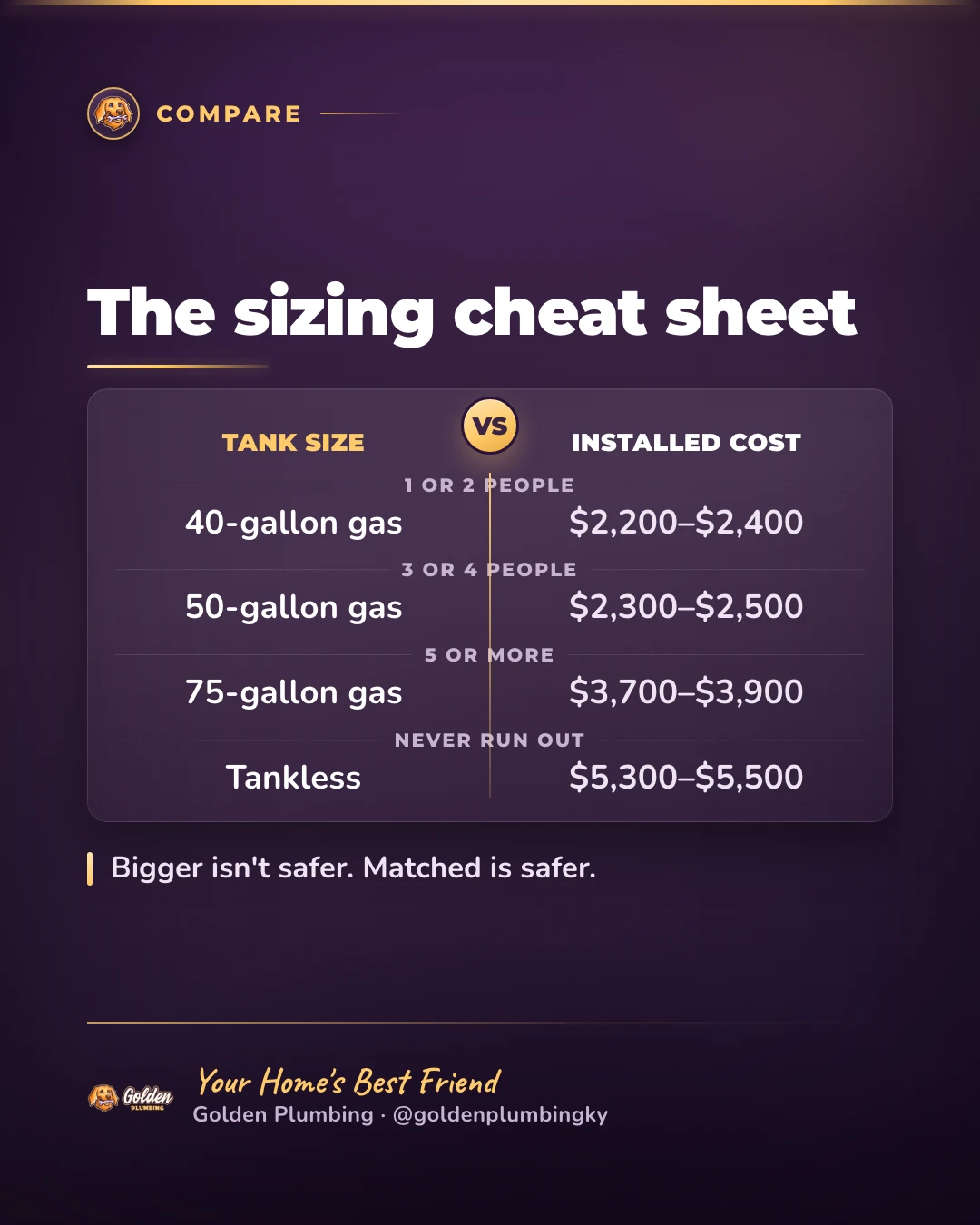
For most Louisville homes the honest chart is short: 1 or 2 people do fine on a 40-gallon tank, 3 or 4 people want a 50, and 5 or more should be looking at a 75-gallon or a tankless. The number that actually decides your mornings isn’t the gallons on the sticker, though. It’s the first-hour rating: how much hot water the heater can deliver in its busiest hour, storage plus reheat speed. Gas reheats roughly twice as fast as standard electric, so a gas 40 keeps up where an electric 40 taps out. Moving up a size is cheap at replacement time, a 40-gallon gas tank runs $2,000–$2,200 installed and a 50 runs $2,200–$2,400, and impossible to bolt on later. Tankless is sized completely differently, in gallons per minute at a winter temperature rise.
When a water heater dies, almost everybody replaces it with the same size that was standing there. Sometimes that’s exactly right. But that dying tank is also the one cheap moment you’ll ever get to fix a sizing mistake, because the upcharge to go bigger at install time is small and the cost of living with the wrong size is ten more years of cold showers, or ten more years of paying to keep hot water you never use. So before you tell anybody to just match what’s there, it’s worth five minutes of honest math. Here’s how we actually size them, the same numbers we run standing in your basement.
The number on the sticker isn’t the one that matters
A tank’s size tells you what it stores. What decides whether the fourth shower goes cold is the first-hour rating: how many gallons of genuinely hot water the unit can deliver in a busy hour, starting full. That’s storage plus recovery, and it’s printed on the yellow EnergyGuide label on every new tank. Recovery is where fuel matters. A gas burner reheats water roughly twice as fast as standard electric elements, which is why a 40-gallon gas tank can out-deliver a 40-gallon electric by a wide margin in that first hour, and why all-electric homes often need to go up a size to buy the same morning.
Match the tank to the headcount
- 1 or 2 people, one bathroom A 40-gallon gas tank covers this with room for a guest, at $2,000–$2,200 installed. All-electric home? A 40-gallon electric runs $1,800–$2,000 and still handles two people fine, as long as back-to-back showers and a laundry load aren’t all landing in the same hour.
- 3 or 4 people This is 50-gallon territory, and it’s the size we install most. A 50-gallon gas tank runs $2,200–$2,400, and between the extra storage and gas recovery it absorbs a normal family morning without anyone scheduling their shower. On electric, a 50 runs $2,000–$2,200, but the slower recovery means a heavy-use family of four should either watch the schedule or look at the hybrid option further down.
- 5 or more people, or a big soaker tub Now you’ve outrun a standard 50. A 75-gallon gas tank runs $3,600–$3,800 installed and exists for exactly this house. The other honest answer at this size is tankless, which never runs out but has to be sized to your flow rather than your headcount. More on that below.
- Heavy hot-water habits count as extra people Two teenagers who shower like it’s a hobby, laundry running every day, a garden tub that swallows 30 gallons a fill. If that’s your house, size like the next household up. The napkin math below will tell you the same thing, just with numbers attached.
Five minutes of napkin math
Here’s the whole method. Figure out your busiest hot-water hour, usually a weekday morning, and add up what runs during it. A typical shower draws about 10 gallons of hot water. A bath takes 15 to 20. A dishwasher cycle pulls 4 to 6, a warm laundry load around 7, and a sink adds a gallon or two. Now compare the total against the first-hour rating of the tank you’re considering, and you want the rating to clear your number with about 10 gallons to spare, because sediment and winter both eat into the margin.
Run a family of four through it: two showers is 20 gallons, someone shaves, and last night’s dishwasher kicks on. That’s roughly 27 gallons, which a healthy 40-gallon gas tank can actually cover. Make it four showers in the same hour and you’ve blown past it. That one change in habits, not the headcount itself, is the real difference between a 40 house and a 50 house. It’s also why we ask about your mornings before we ever quote a size.
Tankless runs on different math entirely
A tankless unit stores nothing, so gallons stop mattering and flow takes over. Every fixture that’s open at the same moment adds gallons per minute: a shower runs about 2 to 2.5 GPM, a kitchen faucet around 1.5, a washing machine about 2. The question isn’t how much hot water your family uses in a morning. It’s the most that can be running at the same instant, because the unit has to keep up with that number every minute it’s happening.
The trap is the rating on the box. That big GPM number is measured with mild incoming water. In a Louisville January the water coming into your house is somewhere around 50 degrees, and the unit has to lift it to 120, so the number to ask for is what it delivers at a 70-degree rise. Plenty of units that advertise 8 or 9 GPM deliver closer to half that in real winter conditions. Two showers at once is 4 to 5 GPM at full rise, which takes a properly sized unit and, in a lot of houses, a bigger gas line than the old tank ever needed. Installed, a mid-efficiency tankless runs $5,200–$5,400 and a high-efficiency unit with recirculation runs $6,000–$6,200. Whether that premium over a tank makes sense for your house is its own question, and we’ve written up the honest tank vs tankless tradeoff separately.
Before you buy a bigger anything
Half our sizing conversations end with us talking somebody out of a bigger tank. Run through these first:
- If it used to keep up and now doesn’t, size isn’t your problem A tank doesn’t shrink because your family got busier. Louisville water runs hard, around 7 grains, and a tank that’s never been flushed loses real capacity to a bed of sediment, so a 50 starts performing like a 40. A flush runs $100–$200, which is a lot cheaper than buying gallons you already own. Start with why hot water runs out fast before you shop sizes.
- Measure the closet before you fall for the 75 Federal efficiency rules that took effect in 2015 wrapped new tanks in thicker insulation, so today’s heaters run an inch or two wider and taller than the unit they’re replacing. A 50 that slid into a 1990s closet can be a genuinely tight fit now, and a 75 is a big cylinder that also needs room to breathe for combustion air. We check clearances before we quote one.
- Oversizing isn’t free A tank keeps every gallon hot around the clock whether you use it or not. Two people running a 75 are paying to reheat standby water all year for capacity they touch twice at Thanksgiving. Bigger isn’t safer. Matched is safer.
- All-electric and always running out Before you jump to gas or tankless, look at an 80-gallon hybrid heat-pump unit, at $7,400–$7,600 installed. It’s the biggest first-hour cushion you can buy on electric and it cuts operating cost, but it needs headroom, a condensate drain, and a space that isn’t a sealed closet.
What the sizes cost in Louisville
Quick recap, installed: a 40-gallon gas tank runs $2,000–$2,200 and a 50 runs $2,200–$2,400, which is exactly why we rarely talk anyone out of the 50 when they’re on the fence. Electric runs $1,800–$2,000 for a 40 and $2,000–$2,200 for a 50. A 75-gallon gas tank is $3,600–$3,800, tankless runs $5,200–$5,400 to $6,000–$6,200 depending on efficiency and recirculation, and the hybrid heat pump is $7,400–$7,600. Kentucky also requires a $50 state permit on a water heater replacement under 815 KAR 20:050, so make sure whoever quotes you includes it. The full line-by-line breakdown by fuel and venting lives in our water heater cost guide. And if you’d rather answer a few questions and get a straight recommendation with a real number, Ask Goldie will size it with you in a couple of minutes.
Common questions we get
What size water heater does a family of 4 need?
In most Louisville homes, a 50-gallon gas tank. Gas recovery plus 50 gallons of storage absorbs a normal family morning without anyone scheduling their shower. On an all-electric home a 50 still works for most families of four, but recovery is slower, so if your crew stacks showers back to back, look at the 80-gallon hybrid heat-pump option or be honest about the morning schedule.
Is a 50-gallon water heater worth it over a 40?
At replacement time, usually yes if you’re anywhere near the line. The installed difference is small, $2,000–$2,200 for the 40 against $2,200–$2,400 for the 50, and you can’t add gallons later. The exception is a one or two person household that’s never once run out. Buying the 50 there just means paying to keep extra water hot for a decade for capacity you’ll never touch.
What size tankless do I need for my house?
Count what can run at the same time, in gallons per minute, then ask what the unit delivers at a 70-degree temperature rise, because that’s what a Louisville January demands. Two showers at once is 4 to 5 GPM at that rise, which most families of four should treat as the floor. And have the gas line checked before anyone orders equipment. Many tankless units need more gas than the tank they replace, and that should be part of the quote, not a surprise after.
Can I just swap my 40 for a 50 in the same spot?
Often, but not automatically. New tanks are wider and taller than older ones thanks to the 2015 insulation rules, so a closet that fit a 2010 tank can pinch a new 50. Venting, the drain pan, and code items like a thermal expansion tank also get checked at swap time, and the $50 state permit applies either way. It’s usually a clean swap. It just isn’t a blind one.
Does Louisville’s hard water change what size I should buy?
It changes the size you keep. Our water runs around 7 grains hard, and sediment quietly shrinks a tank’s usable capacity year after year, so a neglected 50 ends up performing like a 40. An annual flush at $100–$200 protects the gallons you paid for. If you go tankless, that same hardness shows up as scale in the heat exchanger instead, and a periodic descaling flush at $500–$600 becomes part of the routine.
The next questions to ask
Not sure if your house is a 40, a 50, or a tankless?
Ask Goldie asks a few quick questions about your household and hot-water habits and gives you a straight size recommendation with a real price, before anyone comes out. Try it at goldenplumbingky.com/instant-estimate/